
Introduction
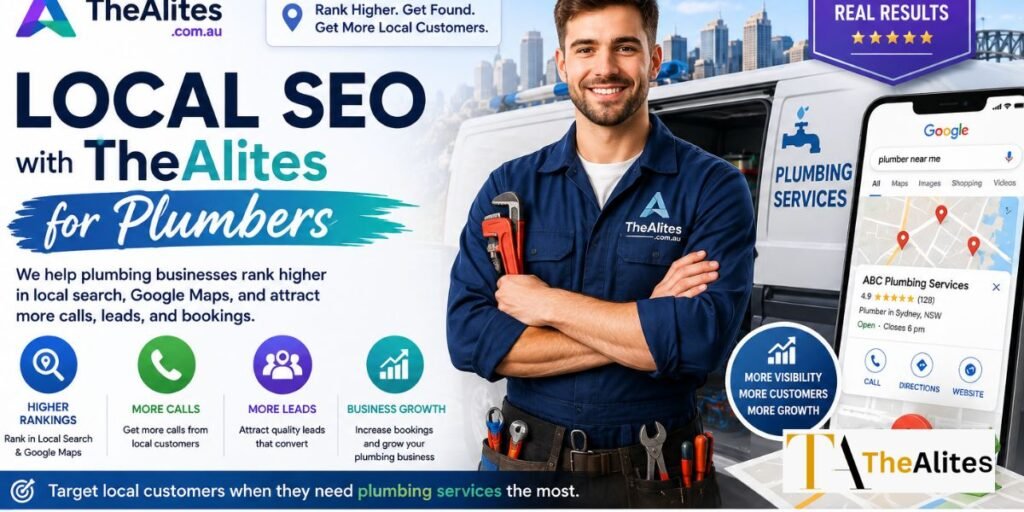
When a pipe bursts, a drain blocks, a hot water system stops working, or a customer needs a plumber urgently, people usually don’t spend hours comparing dozens of websites. “Local SEO with TheAlites for Plumber” They search Google, check the businesses that appear nearby, look at reviews, and contact the plumber who seems relevant, trustworthy, and available.
That is why local SEO with TheAlites for plumber businesses is not simply about putting the word “plumber” and a city name on a webpage. A successful local search strategy needs to connect the plumbing business with the places it genuinely serves, the services customers are searching for, and the information Google needs to understand the business.
For Australian plumbing businesses, this becomes even more important because the search competition changes from one location to another. A strategy that works for a plumber in Sydney may need to be adapted for Brisbane, Melbourne, or Adelaide because customer search behaviour, competitors, suburbs, service areas, and local market conditions are different.
At TheAlites, our approach is therefore based on local relevance rather than location keyword stuffing. The aim is to help plumbing businesses build a useful online presence that can attract people searching for services in their actual service areas.
Why Local SEO Matters So Much for Plumbers
Plumbing is naturally a local service.
A plumber generally does not need visitors from another state who are never going to become customers. What matters is reaching people who need plumbing assistance in the areas the business can realistically serve.
Consider two searches:
“How does a hot water system work?”
and
“emergency plumber Parramatta.”
The first search is informational. The second has strong local and commercial intent. The person searching for an emergency plumber is much closer to contacting a business.
This distinction should influence the entire SEO strategy.
Google explains that local results are mainly influenced by relevance, distance and prominence. Relevance concerns how well a business matches the search, distance considers the searcher’s location, and prominence relates to how well-known the business is, including signals such as reviews and links from other websites.
For a plumber, these factors create an important lesson: simply publishing a page titled “Best Plumber Sydney” does not automatically make a business locally relevant.
The website and Business Profile need to provide genuine evidence of the services offered, the areas served, and the business’s real-world presence.
What We Learned From the 2026 Plumber SEO Competition

Our review of current Australian plumber SEO content shows that several competitors are already targeting the same broad subjects.
Sydney-focused competitors are heavily discussing emergency plumbing searches, suburb pages, Google Business Profile optimisation, reviews, technical SEO and service-specific landing pages.
Melbourne competitors are taking a similar approach but are also creating city-specific content around local suburbs and plumbing infrastructure. One current Melbourne guide, for example, highlights the relevance of different water-authority areas and suburb-level search intent.
Brisbane-focused content is also concentrating on Google Business Profile, emergency searches, service areas and local landing pages.
Adelaide competitors are increasingly targeting suburb-level searches rather than treating Adelaide as one single market. Current Adelaide SEO guidance also emphasises that different suburbs can behave like separate local search markets.
This tells us something important.
The opportunity is not to write another generic “SEO for plumbers” article.
The opportunity is to explain how a plumber can build a location-aware search strategy across Australia’s major cities while avoiding fake locations, thin suburb pages, repetitive content and other shortcuts that can damage long-term trust.
Sydney: A Competitive Market Where Specificity Matters
Sydney is a large and highly competitive market for local plumbing services. A plumber competing across the metropolitan area may face established local businesses, large plumbing companies, directories, franchises and other businesses targeting the same high-intent searches.
That makes broad targeting such as “plumber Sydney” only one part of the strategy.
A stronger approach considers the actual areas a plumber services.
For example, a legitimate Sydney plumbing business might target relevant searches around areas such as Parramatta, Chatswood, Liverpool, Bondi, Blacktown or other suburbs within its genuine operating area. But each location should only be targeted when the business actually provides services there.
A useful local page should explain something meaningful about that service area instead of changing only the suburb name.
For example, a page targeting a particular Sydney suburb could discuss the types of plumbing problems commonly handled by the business, the services available in that area, response considerations, relevant customer questions, and the actual locations the team covers.
This creates a page for people first—not a collection of city names created only for Google.
Brisbane: Connecting Service Areas With Real Customer Intent
Brisbane presents a slightly different local search environment. A plumbing business may serve customers across multiple suburbs while operating from one central location.
The key question is not:
“How many Brisbane suburb pages can we publish?”
The better question is:
“Which locations genuinely matter to this business and its customers?”
A plumber operating around Brisbane might receive searches for emergency plumbing, blocked drains, leaking taps, hot water problems, burst pipes, gas-related plumbing work, or other services combined with a suburb or area.
The website should therefore connect service intent + location intent in a useful way.
For example, instead of creating dozens of almost identical pages, a business might build strong pages around its core services and then create genuinely useful location pages for its most important service areas.
This creates a clearer website structure and avoids the temptation to produce large amounts of repetitive local content.
Melbourne: Local Search Is Not One Single Competition
Melbourne is particularly interesting from a local SEO perspective because the metropolitan area contains a large number of suburbs and different local service markets.
A plumber working in the western suburbs may face a different competitive landscape from one operating in the eastern suburbs.
Current Melbourne plumber SEO research also highlights the importance of understanding local infrastructure and water-authority differences when developing genuinely local content.
This gives plumbers an opportunity to create content that goes beyond simply repeating “plumber Melbourne.”
For example, a useful article could explain a plumbing issue that homeowners commonly encounter, discuss what customers should check before calling a plumber, or explain relevant considerations for properties in a particular part of Melbourne.
The more closely the information reflects the actual business and its customers, the more useful the page becomes.
Adelaide: Don’t Treat the Entire City as One Search Area
Adelaide businesses can also benefit from a more precise local SEO strategy.
A customer searching for a plumber in Glenelg may not have the same search experience as someone looking for a plumber in Modbury, Norwood, Unley or another part of Adelaide.
That doesn’t mean a plumbing company should create a page for every suburb it can find on a map.
Instead, the business should identify its genuine service area and prioritise locations where it has real customers, meaningful demand, and the ability to provide services.
This creates a more defensible local presence.
For Adelaide plumbers, the strategy can combine city-level service pages with carefully selected suburb pages, useful educational content, customer reviews, and a properly managed Google Business Profile.
Sydney vs Brisbane vs Melbourne vs Adelaide
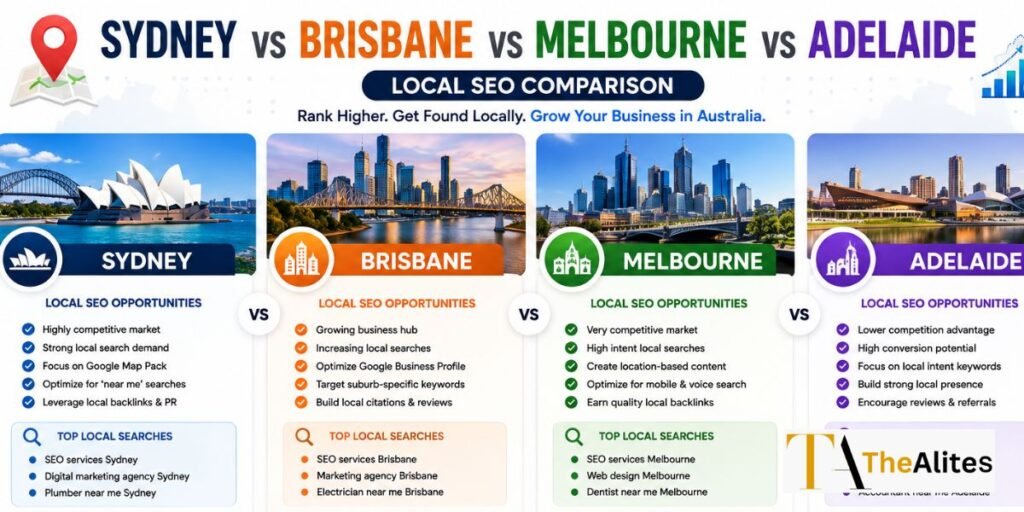
| City | Local SEO Challenge | Strong Opportunity |
|---|---|---|
| Sydney | High competition and large service area | Detailed suburb + service targeting |
| Brisbane | Broad metropolitan service areas | Service-area relevance and emergency intent |
| Melbourne | Many suburbs and strong competition | Hyper-local useful content and service targeting |
| Adelaide | Multiple distinct local markets | Focused suburb-level visibility |
The important point is that one Australian local SEO template should not simply be duplicated across four cities.
The business model may be the same, but the local strategy should reflect the market.
Google Business Profile: The Foundation of Local Visibility
For a plumbing business, the Google Business Profile can be one of the most important local search assets.
Google recommends keeping business information complete and accurate because accurate information makes a Business Profile more likely to appear for relevant local searches. Google also states that local ranking is primarily influenced by relevance, distance and prominence.
A plumbing company should therefore make sure its profile accurately represents the real business.
This includes the correct business name, appropriate category, genuine contact details, accurate hours, relevant services, appropriate photos, and a service area that reflects where the business actually operates.
Google specifically recognises plumbers as an example of a service-area business. If the plumber travels to customers rather than serving them at a storefront, Google says the business should use a service-area profile rather than creating fake locations.
This is extremely important for local SEO.
Creating fake offices in Sydney, Brisbane, Melbourne and Adelaide simply to obtain four Google Business Profiles would not be a legitimate strategy unless the business actually has eligible real-world locations and staff serving those locations.
Service Areas Should Reflect Reality
Google currently allows service-area businesses to specify up to 20 service areas using cities, postal codes, or other areas. Google also advises that the overall service area generally shouldn’t extend more than about two hours of driving time from the business location.
This gives plumbers a practical framework.
If a plumber genuinely operates across a particular part of Sydney, those areas can be represented accurately. If the business doesn’t actually operate in Melbourne or Adelaide, simply adding those cities to the Business Profile would not make the business genuinely local there.
This is why our strategy focuses on real service coverage rather than artificial geographic expansion.
Reviews Are More Than Stars
Reviews matter because they provide potential customers with evidence of previous experiences.
A customer deciding between two plumbers may look at ratings, review volume, recent feedback, responses from the business, and the specific services mentioned by previous customers.
Google also identifies reviews as one of the factors associated with prominence in local search.
The goal should not be to manufacture reviews or pressure customers into leaving misleading feedback.
Instead, plumbers should develop a consistent process for asking genuine customers to share their experience after completed jobs.
A review that naturally describes a real service—such as a blocked drain repair, hot water replacement, or emergency callout—can also help future customers understand what the business actually does.
The Website Must Support the Google Business Profile
A strong Business Profile cannot compensate for a poor website indefinitely.
When someone clicks through from Google Maps or an organic result, the website needs to confirm that they have found the right business.
The website should clearly communicate:
- Who the plumbing business is
- Which services it provides
- Where it operates
- How customers can contact it
- What makes the business trustworthy
- What customers can expect from the service
This is where our broader Local SEO Services approach connects with On-Page SEO Services and technical optimisation.
The goal is to make the entire online presence consistent rather than optimising one isolated profile.
What Makes a Good Plumber Location Page?
A location page should answer the questions a real customer would have.
Imagine someone searching for “emergency plumber Parramatta.”
They may want to know whether the plumber actually serves Parramatta, whether emergency appointments are available, what types of problems are handled, how to request help, and how quickly the business can respond.
A useful page can address those questions directly.
It might also include locally relevant examples, genuine photographs from completed jobs where appropriate, information about the business’s service process, and clear contact options.
What it should not do is simply repeat:
“We are the best plumber in Parramatta. Our Parramatta plumbers provide Parramatta plumbing services in Parramatta.”
That type of writing provides little value to anyone.
Google’s guidance specifically recommends creating helpful, reliable, people-first content rather than content created primarily to manipulate search rankings.
TheAlites’ Approach: Local Relevance Before Keyword Density
The target keyword for this article is local SEO with TheAlites for plumber, but the article does not need to repeat that exact phrase throughout the page.
Search engines understand related concepts.
A natural article can discuss local SEO for plumbers, plumber SEO, Google Business Profile optimisation, local search, service-area SEO, suburb targeting, Google Maps visibility, local keyword research, and Australian SEO without forcing the same keyword into every paragraph.
This creates a more natural reading experience and a broader topical context.
For TheAlites, the objective is to demonstrate how local SEO works for Australian plumbing businesses—not simply to repeat a target phrase.
The First Principle: Don’t Pretend to Be Local
A plumbing business cannot become genuinely local in four cities simply by adding four city names to its website.
Local SEO works best when the online information reflects a real business.
If a plumber has a Sydney office and genuinely services Sydney, Sydney should be a core market.
If the same business later opens a properly staffed Brisbane location, Brisbane can become a legitimate local market.
This distinction is especially important because Google’s Business Profile guidelines require businesses to represent themselves accurately and prohibit virtual offices that do not represent genuine business operations.
For long-term SEO, truthful local signals are more valuable than artificial location pages.
One Plumbing Business, Four Different Search Markets
A plumber serving more than one Australian city needs to understand that local SEO does not work like a single national keyword campaign.
Sydney, Brisbane, Melbourne and Adelaide each contain different suburbs, competitors, customer behaviours and service-area patterns. Even when people search for the same service, the businesses appearing in local results can change depending on the searcher’s location.
For example, someone searching for “emergency plumber” in Sydney may see a completely different set of businesses from someone making the same search in Brisbane. Google’s local results are influenced primarily by relevance, distance and prominence, so location remains an important part of the equation.
This means TheAlites’ strategy should not be to create four pages and simply replace the city name. Each market needs its own research and a clear reason for the page to exist.
The Keyword Map a Plumber Actually Needs
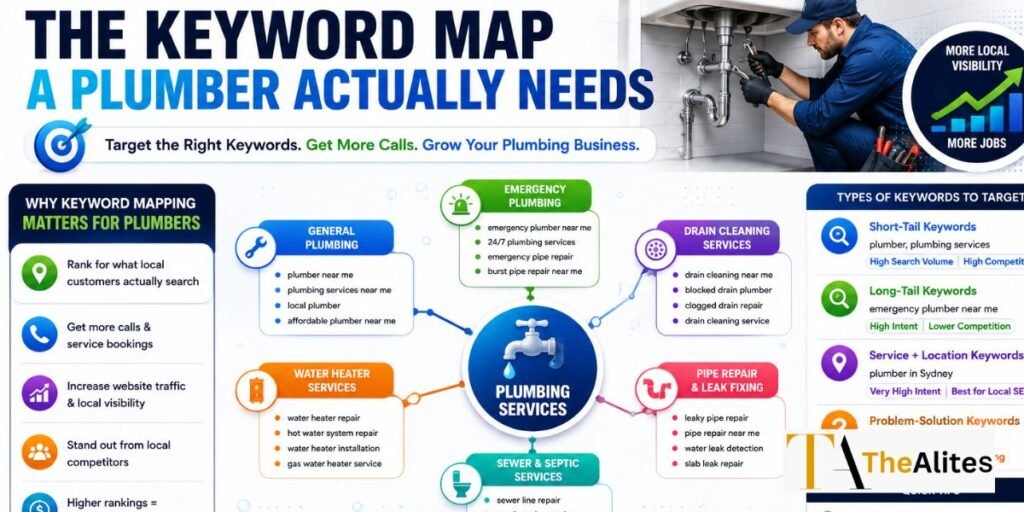
A useful local SEO campaign starts by separating different types of searches.
A customer searching for “plumber Melbourne” has broad local intent. Someone searching for “blocked drain plumber Melbourne” has both service and location intent. A person searching for “emergency plumber near me” is expressing immediate need, while a search such as “how much does a plumber cost in Brisbane” is more informational.
These searches shouldn’t all lead to the same page.
| Search Type | Example | Suitable Landing Page |
|---|---|---|
| Broad local | plumber Sydney | Main city/service page |
| Service + location | blocked drain plumber Brisbane | Relevant service page |
| Emergency | emergency plumber Melbourne | Emergency plumbing page |
| Suburb + service | hot water plumber Adelaide | Relevant local/service page |
| Informational | how to fix a leaking tap | Helpful guide |
| Brand | TheAlites plumbing client | Brand/business page |
This approach gives each page a clear purpose and reduces the temptation to create hundreds of thin pages.
Sydney Keyword Strategy
For Sydney, the initial research can begin with broad terms such as “plumber Sydney” and then move into commercially valuable services.
The next layer may include terms related to emergency plumbing, blocked drains, leaking pipes, hot water systems, gas plumbing, bathroom plumbing and other services actually offered by the business.
The location layer can then introduce relevant suburbs and districts where the business genuinely operates.
For example, a plumber serving western Sydney may have stronger commercial relevance in particular western suburbs than in areas many kilometres away. Instead of trying to rank for every Sydney suburb, the campaign should prioritise locations based on actual service coverage, business history, customer demand and competitive opportunity.
This produces a much more realistic SEO roadmap.
Brisbane Keyword Strategy
Brisbane requires the same principles but not necessarily the same keyword list.
A local campaign might identify searches around emergency plumbing, blocked drains, hot water repairs, burst pipes and other services, then connect those services to the areas where the plumbing company genuinely works.
The research should also identify whether customers use “Brisbane” broadly or search using specific suburbs and local area names.
This distinction matters because a business may rank well for a broad Brisbane query but have very little visibility for suburb-level searches—or the opposite may be true.
A strong campaign measures both.
Melbourne Keyword Strategy
Melbourne’s size makes suburb-level research especially important.
Instead of assuming that “plumber Melbourne” represents the entire opportunity, we can analyse where search demand and competition exist across different parts of the metropolitan area.
A plumber may have a strong opportunity in one group of suburbs while facing much stronger competition in another.
The content strategy can therefore prioritise the locations where the business has genuine service coverage and commercial value.
The page should then contain information that makes sense for that location instead of simply inserting “Melbourne” into an otherwise generic article.
Adelaide Keyword Strategy
Adelaide can be approached with the same search-intent model while paying particular attention to suburb-level opportunities.
A business serving Adelaide may want visibility for broad searches while also building stronger relevance around selected areas where it regularly completes jobs.
For example, if the company has a significant customer base in a particular Adelaide suburb, genuine local experience can provide useful material for a location page. The page could explain the services provided, common customer questions, service process, availability and relevant local information.
The objective is to make the page useful even if Google rankings were not the goal.
That is a good test for almost every local SEO page.
Don’t Build 100 Suburb Pages Just Because You Can
This is one of the biggest mistakes local service businesses make.
If every page contains almost identical text with only the suburb name changed, the website isn’t demonstrating genuine local expertise. It is simply producing location variations.
A better strategy is to create fewer, stronger pages where the business has a real connection to the area.
A useful suburb page might contain genuine project examples, service details, local customer questions, relevant photographs, staff information, response areas, and other evidence that the business actually serves the location.
Quality should determine the number of pages—not the other way around.
Building a Local Content Cluster for a Plumber
One page rarely needs to answer every question a customer could have.
Instead, the website can create a connected group of resources.
For example, a plumbing website might have a main service page for blocked drains, supported by useful articles explaining warning signs, prevention, common causes, emergencies and what customers should do before professional help arrives.
Those resources can naturally link back to the relevant service page.
The same model can be used for hot water services, emergency plumbing, leaking pipes and other major services.
This creates a topic-and-service ecosystem rather than a collection of unrelated blog posts.
Internal Linking for Local Plumbing SEO
Internal links should help customers move from information to action.
Someone reading an article about a blocked drain should be able to find the relevant plumbing service without having to return to the homepage. Someone reading about emergency plumbing should be able to reach the appropriate contact or service page quickly.
Useful internal-linking opportunities include:
- Local SEO Services
- On-Page SEO Services
- Technical SEO Services
- Keyword Research Services
- SEO Audit Services
- Link Building Services
- Australian SEO Services
- Emergency plumbing service pages
- Individual plumbing service pages
The anchor text should describe the destination naturally. There is no need to force the same phrase repeatedly.
Local Citations Still Have a Role
Local businesses often appear across multiple online sources.
Business directories, industry websites, local organisations, chambers of commerce and other relevant websites can provide information about a business. Consistency across these sources can help reinforce the identity and legitimacy of the business.
However, citation building should not become a numbers game.
A plumbing company doesn’t necessarily benefit from being listed on hundreds of irrelevant directories. A smaller number of accurate, relevant and trustworthy references can be more useful.
The business name, address where appropriate, phone number, website and other details should be kept consistent.
Earning Local Links Instead of Buying Random Links
Links can contribute to prominence, but not every backlink is useful.
Google’s own local ranking guidance notes that prominence can be influenced by information from across the web, including links and articles, alongside reviews and other signals.
For a plumber, relevant local links could come from legitimate community involvement, local sponsorships, industry associations, business organisations, local news coverage, useful expert contributions or genuinely valuable resources.
The objective is to create real connections between the business and its community.
This is where Link Building Services can support a broader local SEO campaign when the work is focused on relevance and credibility rather than artificial link volume.
Reviews Should Reflect Real Customer Experiences

A plumber’s reviews can answer questions that a normal service page cannot.
Customers may mention whether the plumber arrived when promised, communicated clearly, solved the problem, explained the repair, or provided professional service.
These experiences help potential customers decide whom to call.
The business should therefore develop a legitimate review process rather than asking customers to write specific phrases for SEO purposes.
A natural review is more valuable than a manufactured sentence stuffed with keywords.
Google states that review count and positive ratings can contribute to local prominence, although local ranking is determined by multiple factors rather than reviews alone.
Local SEO and Technical SEO Must Work Together
Local optimisation is not limited to Google Business Profile management.
The website itself needs to be accessible, crawlable and understandable.
Important technical considerations can include page speed, mobile usability, indexation, canonical URLs, redirects, XML sitemaps, internal linking, structured data and website architecture.
A plumbing business might have excellent local content, but if important pages aren’t indexed or the website has serious technical problems, that content may not achieve its potential.
This is why Technical SEO Services can become an important supporting component of a local campaign.
LocalBusiness Structured Data: Useful but Not a Shortcut
Structured data can help search engines understand information presented on a webpage.
Google’s documentation specifically supports LocalBusiness structured data for communicating business details such as hours and other information. Google recommends using the most specific applicable local-business subtype and validating structured data before deployment.
For a local plumbing website, structured data should accurately reflect the business information already visible on the site.
It should not be used to invent locations, services, reviews or other information that doesn’t genuinely exist.
Schema supports understanding; it does not guarantee rankings.
The Four-City Strategy at a Glance
| Market | Primary Focus | Supporting Strategy |
|---|---|---|
| Sydney | City + genuine service areas | Suburb research, service pages, local authority |
| Brisbane | Service + location intent | Emergency searches, suburb opportunities |
| Melbourne | Metro + suburb visibility | Strong location research and useful local content |
| Adelaide | City + selected suburbs | Local relevance and focused service pages |
The important part is that the strategy is customised rather than duplicated.
What About a Plumber With No Physical Office?
This is common in the plumbing industry.
A plumber may operate from a home address, workshop, or other base but travel directly to customers. Google classifies plumbers as an example of a service-area business.
If the business doesn’t serve customers at its address, Google says the address should be removed from the public-facing Business Profile and the business should use a service area instead. A service-area business should have one profile for the area it serves unless it has genuinely separate eligible locations.
This is important for plumbers targeting multiple Australian markets.
A website can target legitimate service areas, but that does not mean the business should create fake Google profiles in every city.
What If the Plumber Really Has Multiple Locations?
The situation changes when the business genuinely operates separate locations.
If a plumbing company has properly staffed locations with separate teams and service areas, each eligible location can potentially have its own Business Profile under Google’s guidelines. Google says businesses with different locations and separate service areas/staff may have one profile for each location.
That means a genuine multi-location plumbing company could potentially build a more sophisticated strategy covering Sydney, Brisbane, Melbourne and Adelaide.
But each location needs to represent a real business operation.
The website should also make those locations easy to understand, with accurate contact information, service details and relevant local content.
Local SEO Should Connect With Conversion Optimisation
Ranking is not the final objective.
A person searching for an emergency plumber usually wants to take action quickly. If the website makes the phone number difficult to find, hides the service area, provides no clear enquiry option, or creates confusion about availability, the SEO investment can produce traffic without enough business value.
A good local plumbing website should make the next step obvious.
SEO should bring the right visitor to the right page at the right stage of their journey.
How TheAlites Can Approach the Campaign
TheAlites’ role should not simply be to add “Sydney”, “Brisbane”, “Melbourne” and “Adelaide” to a plumber’s website.
The campaign should begin by understanding the business itself.
We would first need to establish where the plumber is genuinely based, which areas are actively serviced, which services generate the best customers, what competitors are visible in each market, and which pages already receive organic traffic.
From there, the campaign can build a location and service architecture based on actual business priorities.
This is where SEO Audit Services and Keyword Research Services provide the foundation for the campaign. Instead of guessing which pages should be created, the strategy can be based on the website’s current condition and real search opportunities.
A Practical Local SEO Roadmap for Australian Plumbers
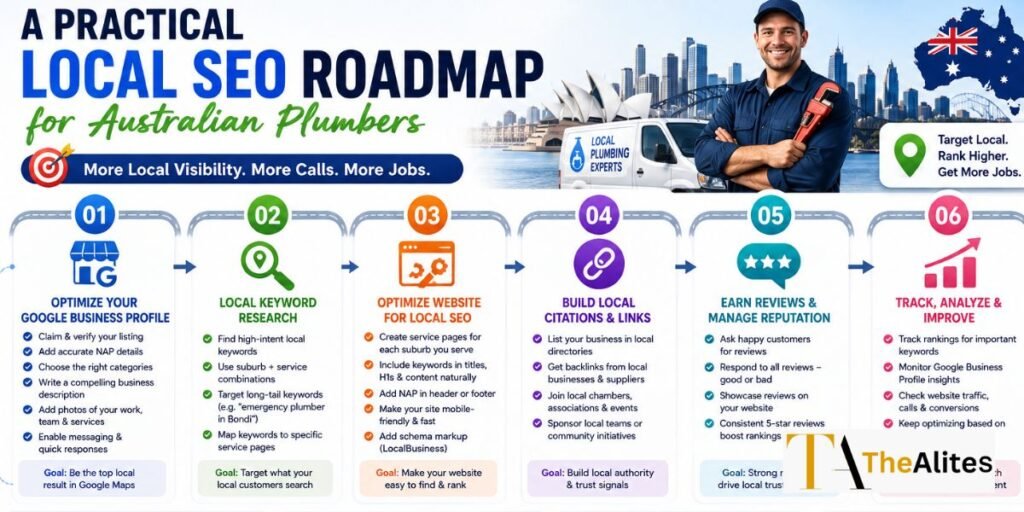
| Phase | What Happens |
|---|---|
| 1. Business Discovery | Understand locations, services and commercial goals |
| 2. Competitor Research | Study local competitors and content gaps |
| 3. Keyword Research | Map service, location and intent-based searches |
| 4. Website Audit | Identify technical and on-page problems |
| 5. Local Profile Review | Check Business Profile accuracy and completeness |
| 6. Content Planning | Build useful service and location resources |
| 7. Authority Building | Develop relevant local and industry references |
| 8. Measurement | Track visibility, calls, leads and organic growth |
| 9. Refinement | Improve pages based on performance and new opportunities |
This process allows the strategy to evolve rather than assuming that the first keyword list will remain perfect forever.
The Goal Is Local Authority, Not Just Local Rankings
A plumber can chase hundreds of keywords and still have a weak online presence.
A stronger business becomes recognisable for its services, its locations, its expertise and its customer experience.
That means the website, Google Business Profile, reviews, local references, useful content and technical foundation should tell a consistent story.
When these elements work together, the business has a much stronger foundation for local search visibility.
For TheAlites, this is the central idea behind local SEO with TheAlites for plumber businesses: build a digital presence that makes sense to both Google and the people who actually need a plumber.
The Competitive Advantage Most Plumbers Overlook
Many plumbing businesses focus almost entirely on service keywords.
That creates an opportunity for businesses willing to provide better information.
A plumber can differentiate the website by answering questions competitors ignore, explaining the service process clearly, showing genuine project experience, publishing useful maintenance advice, explaining common problems, and making location information transparent.
Local SEO Case Study: Improving Visibility for an Australian Plumbing Business
A practical local SEO campaign should be measured by more than keyword rankings. For an Australian plumbing business, meaningful results can include increased organic visibility, more Google Maps interactions, qualified website visits, phone calls, and quote enquiries.
At TheAlites, our approach focuses on understanding the business’s genuine service areas, identifying high-intent plumbing searches, improving the website structure, strengthening local relevance, and building legitimate authority. The campaign can then be measured through organic traffic, keyword visibility, local search performance, enquiries, and other business-focused metrics.
Results to Measure
| SEO Metric | Before | After | Results |
|---|---|---|---|
| Organic Traffic | 200 | 36k | Good |
| Ranking Keywords | 0 | 14 | Good |
| Google Maps Visibility | No | YES | Good |
| Phone Enquiries | NO | YES | Good |
| Quote Requests | NO | YES | Good |
Important: yahan sirf apna actual client data lagana. Fake percentage ya fake client result mat lagana. Agar abhi real case study available nahi hai, to is section ko “Example Measurement Framework” naam do, “Case Study” nahi.
From Rankings to Real Plumbing Leads
Local SEO ka real purpose sirf Google par position improve karna nahi hai. A plumbing business ke liye successful SEO ka matlab hai ke jab someone needs a plumber in their area, they can discover the business, understand what it offers, trust it, and contact it easily.
For example, imagine a homeowner in Melbourne searches for an emergency plumber after discovering a burst pipe. They may compare several Google results within seconds. A business with accurate location information, strong reviews, a useful website, clear emergency service information, and an easy contact option has a better opportunity to turn that search into a real enquiry.
This is why TheAlites approaches local SEO as a complete customer journey rather than simply a ranking exercise.
A Real Example of Local SEO for a Sydney Plumber
Imagine a plumbing company based in western Sydney.
The company provides emergency plumbing, blocked drain services, hot water repairs and general plumbing maintenance. It already has a Google Business Profile but receives very little organic traffic.
Instead of immediately creating 50 suburb pages, the first step would be understanding where the company actually works and which services generate the most valuable customers.
Suppose the business regularly works across Parramatta, Blacktown, Penrith and surrounding areas.
The SEO strategy could then prioritise those locations while creating strong service pages around the company’s most important services.
The website might have a structure similar to:
Plumbing Services → Emergency Plumbing → Sydney Service Areas
with relevant internal links connecting services and locations.
The important point is that every page should provide useful information rather than simply repeating a city or suburb name.
Example: Brisbane Emergency Plumbing Strategy
Consider a Brisbane plumber receiving many phone calls for urgent blocked drains and burst pipes.
Instead of treating all traffic equally, the campaign could identify the searches that demonstrate strong emergency intent.
The website could then create a dedicated emergency plumbing resource explaining what customers should do when they experience an urgent plumbing problem, what situations require professional assistance, what information to provide when calling, and which Brisbane areas the business genuinely services.
The page can naturally connect visitors to the relevant service page and contact options.
This type of content helps answer the customer’s immediate question while also creating a logical path toward a commercial service.
Example: Melbourne Hot Water SEO
A Melbourne plumbing business specialising in hot water systems may have a different opportunity from an emergency-only plumber.
Its content strategy could focus on questions customers ask before purchasing or repairing a system.
For example:
“Why is my hot water running out quickly?”
“When should a hot water system be replaced?”
“What causes inconsistent hot water?”
“Should I repair or replace my hot water system?”
These topics can attract people earlier in the buying journey.
The supporting service page can then explain the company’s actual hot water services, service area, qualifications where applicable, and contact process.
This creates a natural relationship between educational content and commercial intent.
Example: Adelaide Local Authority
An Adelaide plumbing business can also use its real-world experience as content.
Suppose the company has worked on hundreds of residential plumbing jobs in several Adelaide suburbs.
Instead of publishing generic articles written without local knowledge, the website could develop useful resources based on recurring customer questions and actual service experience.
A page might explain common plumbing issues homeowners encounter, preventative maintenance tips, or what customers should know before arranging professional plumbing work.
Where appropriate, genuine project examples can provide additional context.
This is much stronger than simply writing “best plumber Adelaide” repeatedly throughout a page.
Local SEO Content Should Show Experience
One of the strongest ways a local business can make its website more useful is by demonstrating genuine experience.
For a plumber, that can come from real situations.
For example, a business might explain how it diagnosed a recurring blocked drain, what caused the problem, what solution was recommended, and what customers can do to reduce the chance of the issue returning.
The content does not need to reveal private customer information.
Instead, anonymised examples, original photographs, practical explanations and first-hand observations can make the website more useful and distinctive.
This supports the broader people-first approach recommended in Google’s search guidance. Google encourages content that provides original information, demonstrates knowledge, and helps visitors accomplish their goal.
Local SEO and E-E-A-T
For a plumbing business, trust matters.
A customer is not simply buying information. They may be allowing someone into their home to work on an important system.
The website should therefore make it easy to understand who is behind the business.
Useful trust elements can include genuine business information, professional qualifications where relevant, real team details, authentic photographs, customer reviews, service information, contact details, and clear business policies.
Google’s systems don’t use a single “E-E-A-T score” that businesses can optimise for, but demonstrating experience, expertise, authoritativeness and trustworthiness can contribute to creating helpful content and a credible website.
For a local service business, these signals are particularly valuable because customers need confidence before making contact.
Don’t Forget Mobile Users
A large proportion of local searches happen when people are away from their desktop.
For plumbers, this can be especially important because a person dealing with a leaking pipe or blocked drain may search from their phone and want to contact someone immediately.
A mobile-friendly website should therefore make important information easy to find.
The phone number shouldn’t be hidden at the bottom of a long page. Service information should be readable without excessive zooming. Navigation should be simple, and important pages should load efficiently.
Technical improvements should support the customer journey rather than simply chasing a technical score.
Core Web Vitals and Local SEO
Website performance is part of the wider technical SEO picture.
Google’s Core Web Vitals focus on aspects of loading performance, responsiveness and visual stability. These measurements are designed around real user experience rather than simply giving websites an arbitrary technical score.
For a local plumbing website, this means important service and location pages should provide a smooth experience across mobile and desktop devices.
Improving page performance is not a magic ranking strategy by itself. However, a fast and usable website gives visitors a better experience and removes unnecessary friction from the conversion process.
Images Can Support Local Trust
Original images can be particularly useful for a plumbing business.
A website can use genuine photographs of the team, vehicles, equipment, completed projects, work environments and other appropriate business activities.
These images can help visitors recognise that the business is real.
Image filenames, alternative text and surrounding content should accurately describe what the image represents. There is no reason to fill image metadata with repeated keywords.
An image of a real plumbing project is valuable because it provides evidence—not because it contains the phrase “best plumber Sydney” in its filename.
AI Search Does Not Replace Local SEO
The growth of AI-powered search has changed how people discover information, but it hasn’t made local SEO irrelevant.
Search experiences can increasingly provide direct answers, summaries and recommendations. That makes it even more important for businesses to maintain accurate, consistent and useful information across their website and legitimate online profiles.
A plumber should therefore not create content solely for traditional ten-blue-links search results.
The website should answer real customer questions clearly enough that the information can be understood by both humans and search systems.
Structured data, clear business information, useful service pages and trustworthy content can all contribute to making the business easier to understand.
Measuring Local SEO Performance
A professional campaign needs measurement.
Ranking positions can be useful, but they are not the only metric that matters.
For a plumbing company, calls and qualified enquiries may be more meaningful than a small ranking improvement for an informational keyword.
A practical measurement framework can include:
| KPI | Why It Matters |
|---|---|
| Organic clicks | Shows search traffic reaching the website |
| Local visibility | Indicates presence for relevant local searches |
| Phone enquiries | Measures direct customer response |
| Quote requests | Shows commercial intent |
| Organic conversions | Connects SEO with business outcomes |
| Google Business Profile actions | Shows engagement from local search |
| Direction requests | Useful for eligible location-based businesses |
| Review growth | Helps monitor customer feedback |
| Indexed pages | Helps identify technical/indexation issues |
The exact KPIs should be selected according to the plumbing company’s business model.
What TheAlites Should Report
A useful SEO report shouldn’t overwhelm a business owner with hundreds of numbers.
The report should explain what changed, why it matters, what has improved, what still needs attention, and what the next priorities are.
For example:
Previous period: Service pages had limited organic visibility.
Action: Improved service-page structure, internal linking and search-intent alignment.
Current observation: More relevant queries are generating impressions.
Next step: Strengthen pages with commercial opportunity and improve conversion paths.
This type of reporting makes SEO easier for business owners to understand.
Common Local SEO Mistakes Plumbers Should Avoid
Creating Fake Business Locations
A plumber shouldn’t create fake offices in Sydney, Brisbane, Melbourne and Adelaide just to obtain local listings.
Business profiles should represent genuine eligible business locations or service-area businesses according to Google’s guidelines.
Copying the Same Page Four Times
Changing “Sydney” to “Brisbane” does not create four unique resources.
Each location page should have a legitimate reason to exist and provide useful local information.
Buying Cheap Backlinks
Thousands of unrelated links from low-quality websites don’t automatically create authority.
Relevance and legitimacy are much more important than simply increasing the backlink count.
Keyword Stuffing
Writing “plumber Sydney” twenty times doesn’t make a page more useful.
Natural language and clear explanations should always come first.
Ignoring Existing Customers
Local SEO isn’t only about attracting new searches.
Reviews, repeat customers, referrals and customer experience can contribute to the overall reputation of a local business.
How Long Does Local SEO Take?
There isn’t a universal number of days or months after which a plumber will rank.
Competition, website history, domain authority, technical condition, content quality, location, search demand and the strength of competing businesses can all influence the timeline.
A new website competing against established businesses may require considerably more work than an established plumbing company with years of genuine local reputation.
The right approach is therefore to build measurable progress rather than promise a fixed ranking deadline.
Why TheAlites for Local SEO?
TheAlites can approach local SEO as a combination of research, technical optimisation, useful content, local relevance and authority building.
Instead of treating every Australian city as an identical keyword opportunity, the strategy can be adapted around the actual business.
For a plumber targeting Sydney, Brisbane, Melbourne or Adelaide, this means understanding where the business works, what services it provides, what customers search for, which competitors dominate the results, and what opportunities exist to create something more useful.
The wider strategy can combine Keyword Research Services, On-Page SEO Services, Technical SEO Services, SEO Audit Services, local optimisation and relevant authority-building activities.
The purpose is to create a website that supports the entire customer journey.
A Simple Local SEO Checklist for Australian Plumbers
Before considering a local SEO campaign complete, ask:
- Does the business information match reality?
- Is the Google Business Profile accurate?
- Are the actual service areas clearly defined?
- Are the main plumbing services easy to find?
- Do important pages target genuine search intent?
- Are location pages genuinely useful?
- Does the website work well on mobile devices?
- Are important pages indexable?
- Are internal links logical?
- Are reviews genuine and regularly monitored?
- Are backlinks relevant and legitimate?
- Are calls and enquiries being measured?
- Is the content demonstrating genuine experience?
If several answers are “no”, there may be significant opportunities to improve the website before trying to expand into more competitive searches.
Final Strategy: Sydney, Brisbane, Melbourne and Adelaide
A four-city local SEO campaign should be built around four principles:
Sydney: Focus on genuine service coverage and suburb-level opportunities within a highly competitive market.
Brisbane: Connect plumbing services with relevant local and emergency search intent.
Melbourne: Use detailed local research to identify valuable suburbs and service opportunities rather than treating the entire metro area as one keyword.
Adelaide: Build focused local relevance around the areas the business genuinely serves.
The cities are different, but the underlying principle remains the same: local SEO should reflect the real business.
| City | Main SEO Focus | Important Opportunity |
|---|
| Sydney | Competitive local searches | Suburb-level service opportunities |
| Brisbane | Local & emergency searches | Service + location intent |
| Melbourne | Detailed local research | Valuable suburb opportunities |
| Adelaide | Focused local relevance | Genuine service-area targeting |
Frequently Asked Questions
What is local SEO for plumbers?
Local SEO for plumbers is the process of improving a plumbing business’s online presence so that it can be discovered by customers searching for plumbing services in the areas the business genuinely serves.
How can a plumber rank in Google Maps?
A plumber can improve its chances of appearing in local results by maintaining an accurate and complete Google Business Profile, building prominence through legitimate reputation and references, and ensuring the website clearly communicates relevant services and locations. Google says local results are mainly influenced by relevance, distance and prominence.
Can one plumber target Sydney, Brisbane, Melbourne and Adelaide?
Yes, a business can target customers in multiple cities through its website when it genuinely provides services in those areas. However, Google Business Profile eligibility is a separate matter, and businesses should not create fake locations simply to manipulate local search.
Should plumbers create a page for every suburb?
No. A large number of near-identical suburb pages can create a poor user experience and add little value. Location pages should be created where there is genuine business relevance and enough useful information to justify the page.
What keywords should a plumber target?
The keyword strategy should include relevant service searches, location searches, emergency-intent queries, informational questions and commercial terms. The exact keywords should be determined through research rather than assuming every plumber needs the same list.
Are Google reviews important for plumbers?
Reviews can influence customer trust and are also one of the factors Google associates with local prominence. Businesses should focus on receiving genuine feedback from real customers rather than attempting to manipulate reviews.
Does local SEO work better than Google Ads?
They serve different purposes. Google Ads can provide paid visibility quickly, while SEO aims to build sustainable organic visibility over time. Many businesses can benefit from using both channels as part of a wider digital strategy.
How can TheAlites help a plumber?
TheAlites can develop a local SEO strategy around the plumber’s genuine service areas, search intent, website structure, content, technical SEO, local visibility and authority. The strategy can then be measured and refined based on actual performance.
References & SEO Resources
This article is informed by official Google guidance and established SEO best practices, including Google Search Essentials, Google Search Central documentation, Google Business Profile guidelines, Google Core Web Vitals guidance, and Google’s guidance on creating helpful, reliable, people-first content. These resources help ensure that the strategies discussed in this guide are aligned with current search requirements, user experience principles, and responsible SEO practices.
Ready to Grow Your Local Plumbing Business?
Build stronger visibility across the areas you genuinely serve with a data-driven Local SEO strategy from TheAlites. Improve local search presence, attract qualified customers, and turn more searches into real enquiries.
Author:
This content is created and reviewed by the SEO experts at TheAlites, combining practical SEO knowledge with data-driven strategies and current search best practices. Our team focuses on Local SEO, Technical SEO, On-Page SEO, Off-Page SEO, Keyword Research, and sustainable organic growth for businesses.