
This article was written by a Senior SEO Specialist at TheAlites and reviewed by the company’s SEO Director. With over 10 years of experience in SEO and AI Search Optimisation, the content reflects practical industry knowledge and current search best practices.
A website can have excellent design, useful services, and well-written content, yet still struggle to compete in Google. One reason is that search engines need more than information on your own website to understand how trustworthy and authoritative your business is within its industry. This is where a well-planned link-building strategy can make a meaningful difference.
Link Building Services focus on earning relevant references from other websites that can help people discover your business, understand your expertise, and navigate to useful resources. A strong backlink is not simply a URL placed on another website. It is a recommendation, citation, editorial reference, or resource connection that exists because your content or business provides genuine value.
Google continues to use links as one way to discover pages and understand their relevance, while also recommending that links and anchor text provide useful context for people and search engines.
For Australian businesses, this becomes particularly important when competing in crowded markets. A company may have strong content and a technically healthy website, but competitors with stronger industry recognition can still have an advantage. The right link acquisition strategy can help close that gap by building relationships with relevant websites and creating assets that people have a genuine reason to reference.
At TheAlites, our approach is focused on sustainable authority rather than chasing an arbitrary number of backlinks. We look at relevance, quality, context, editorial value, and the overall purpose of each link opportunity. The objective is to build an authority profile that makes sense for your business and supports your wider SEO strategy.
What Modern Link Building Actually Means
The phrase “link building” is often misunderstood.
Some businesses associate it with submitting websites to hundreds of directories, buying guest posts in bulk, exchanging links with other companies, or creating large numbers of backlinks using automated software. These approaches may produce links, but they do not necessarily create genuine authority—and some can violate Google’s spam policies when their primary purpose is manipulating rankings.
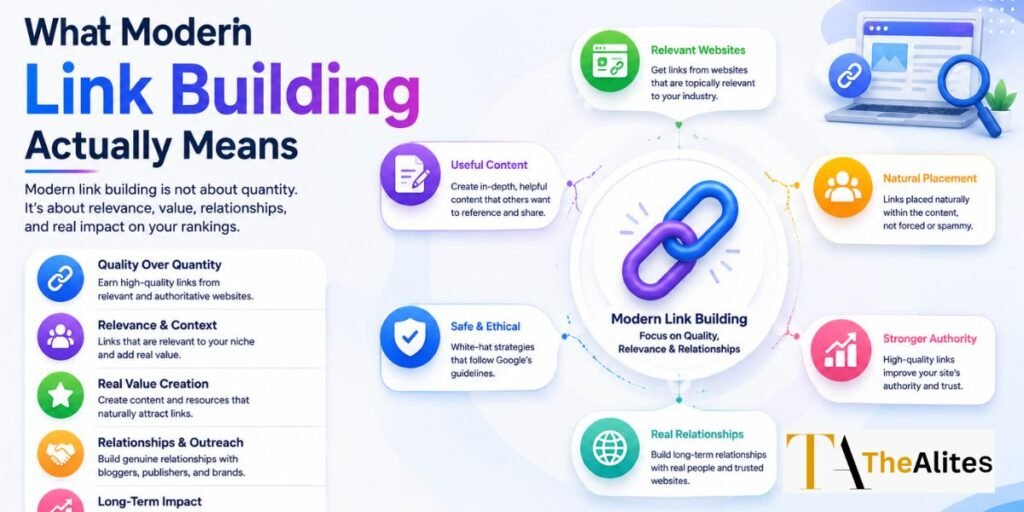
Modern link building is better understood as earning meaningful references from relevant sources.
A useful link can introduce your brand to a new audience, support a piece of research, provide additional context to a reader, or point users toward an original resource. When the link exists because it benefits people rather than simply because someone wants to manipulate rankings, it has a much stronger reason to exist.
This philosophy changes how an SEO agency approaches outreach. Instead of asking, “How many backlinks can we create this month?”, the better question is, “What can we create or promote that reputable websites would genuinely want to reference?”
Types of Link Building
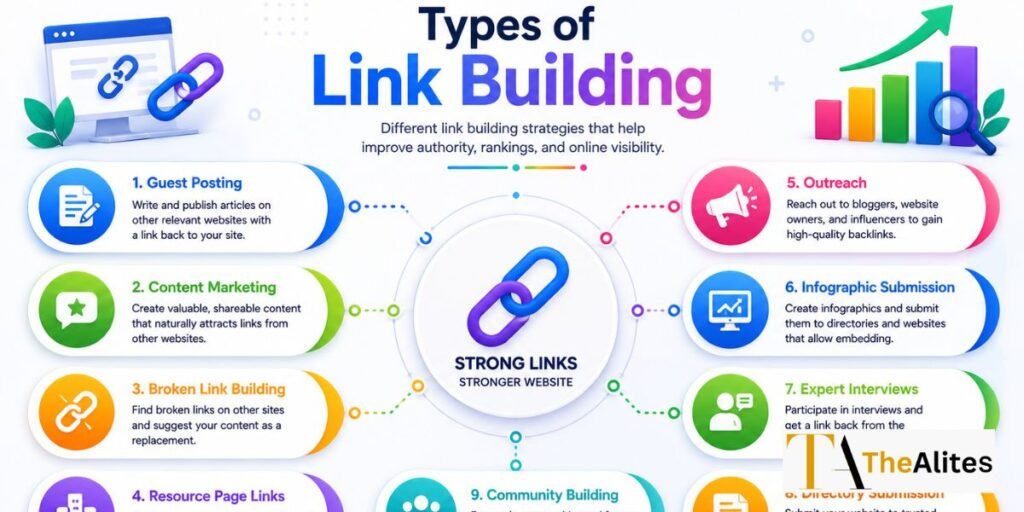
Link building is not a single tactic. Different businesses need different methods depending on their industry, audience, content assets, competition, and goals. A strong campaign usually combines several legitimate approaches rather than depending on one source of backlinks.
Digital PR and Editorial Outreach
Digital PR involves creating original research, expert commentary, newsworthy insights, data, or resources that journalists and publishers may want to reference. When a publisher independently chooses to mention the business or its resource, the resulting link can support both visibility and referral traffic.
Resource Link Building
Resource pages are created to help users find useful information on a particular topic. If your business has a genuinely useful guide, research report, tool, checklist, or educational resource, relevant resource pages may provide legitimate opportunities for inclusion.
Broken Link Building
Broken link building involves finding relevant pages that contain outdated or broken external links and identifying whether your website has a useful replacement resource. The objective is not to ask for a link simply because you want one. The replacement should improve the page for its readers.
Unlinked Brand Mentions
A business may already be mentioned online without receiving a hyperlink. Where appropriate, these mentions can create opportunities to contact the publisher and suggest a relevant page that provides additional information.
Link Reclamation
Link reclamation focuses on recovering valuable links that have been lost because of URL changes, deleted pages, website migrations, redesigns, or changes in the referring website’s content.
Expert and Industry Contributions
Businesses can also earn visibility by contributing genuine expertise to relevant industry publications, professional organisations, interviews, podcasts, research projects, and expert roundups. The primary value should come from sharing useful knowledge with the audience, not from securing a keyword-rich backlink.
Competitor Link Gap Analysis
Competitor research can reveal publications, organisations, resources, and content formats that are relevant to your industry. The goal is not to copy every backlink a competitor has earned. Instead, the research can reveal opportunities to create better resources and develop relationships with relevant sources.
The best strategy depends on the business. A technology company may benefit from research and expert commentary, while a professional-services firm may have stronger opportunities through industry resources, associations, local publications, and original guides.
Why Backlink Quality Matters More Than a Big Number
A website with thousands of backlinks is not automatically more authoritative than a website with a smaller number of highly relevant references.
Imagine two Australian businesses competing in the same industry. One has accumulated hundreds of unrelated links from low-quality websites, while the other has earned a smaller number of contextual references from respected publications, industry resources, professional organisations, and relevant websites.
The second profile may provide a much more meaningful picture of the business’s reputation.
This is why we don’t treat backlink count as the primary measure of success. We evaluate the relevance of referring domains, the context surrounding the link, the quality of the source, the reason the link exists, and whether it contributes to a natural online reputation.
Quality also protects your long-term SEO strategy. Google identifies manipulative link practices as link spam, including buying or selling links for ranking purposes, excessive link exchanges, automated link creation, and certain paid editorial placements that pass ranking credit.
The Difference Between a Link and a Recommendation
Not every backlink should be viewed as a vote of confidence.
A link can exist for navigation, advertising, sponsorship, attribution, user-generated content, editorial reference, or many other reasons. The context matters.
For example, a journalist may reference your original research because it supports an article. An industry website may cite your guide because it helps its readers understand a complex subject. A business association may mention your organisation because you are a relevant member or resource.
These situations are fundamentally different from creating hundreds of links solely to influence rankings.
Our approach therefore considers the reason behind the link before considering the link itself. When a reference makes sense to the reader, it has a legitimate place within the web ecosystem.
Relevance Is the Foundation of a Strong Link Profile
A backlink from a website that has nothing to do with your industry may provide little meaningful context.
For an Australian accounting firm, a contextual mention from a respected finance, business, or professional-services resource may make considerably more sense than a random backlink from an unrelated website. Likewise, an Australian technology company should ideally build relationships with sources that understand technology, business, innovation, software, or its specific market.
This is why our outreach begins with research.
We identify websites, publications, communities, organisations, and content opportunities that are genuinely relevant to the business. The goal is not to manufacture a pattern of links but to build connections that make sense within the wider online environment.
This relevance-first philosophy also complements Keyword Research Services, because understanding what your audience searches for can reveal the topics, resources, and content assets that deserve promotion.
Link Building Begins Before Outreach
Successful link acquisition does not start with sending emails.
It starts with understanding what you have that other websites might reasonably want to reference.
A useful digital asset could be original research, a detailed industry guide, a useful calculator, an expert resource, a data study, an informative visual, a unique case study, or a genuinely comprehensive explanation of a complicated subject.
Before outreach begins, we evaluate the website’s existing content and identify opportunities to strengthen assets that have genuine reference potential.
This is where link building connects naturally with On-Page SEO Services. A page needs to provide value before there is a compelling reason for another website to recommend it.
Content Gives Link Building a Reason to Exist
The strongest outreach campaigns are often built around something worth sharing.
If a business publishes the same generic article that thousands of websites already contain, convincing authoritative publishers to reference it can be difficult. On the other hand, original research, useful data, expert commentary, or genuinely comprehensive resources can give publishers a clear reason to link.
At TheAlites, we therefore view content and authority building as connected activities. Our Content Writing Services can support the creation of useful resources, while outreach can help place those resources in front of people and publishers who may find them valuable.
The goal is not to create content simply because “more content means more backlinks.” The goal is to create something useful enough that a backlink becomes a natural outcome of its value.
What Are Linkable Assets?
A linkable asset is a useful piece of content, data, research, tool, or resource that other websites have a genuine reason to reference.
Instead of starting outreach with the question, “Who can give us a backlink?”, a stronger strategy starts with, “What can we create that deserves to be referenced?”
Common linkable assets include:
| Linkable Asset | Why It Can Attract Links |
|---|---|
| Original Research | Publishers can reference unique findings and data |
| Industry Statistics | Useful as a source for articles and reports |
| Comprehensive Guides | Provide detailed information readers can reference |
| Case Studies | Offer real-world examples and evidence |
| Calculators and Tools | Provide practical value to users |
| Original Surveys | Create unique data that other publishers may cite |
| Expert Commentary | Adds specialist insight to industry coverage |
| Checklists | Give readers a practical resource they can save and share |
| Visual Resources | Make complex information easier to understand |
| Industry Reports | Provide original analysis and market insights |
A linkable asset does not have to be complicated. Its value comes from being useful, original, credible, or particularly convenient for the intended audience.
For example, an Australian accounting firm could create a detailed small-business tax checklist, while a technology company could publish original research about software adoption trends. A professional services company could create an industry benchmark report or a practical calculator.
The important point is that the asset should provide value even if no backlink is created. That makes outreach more natural and reduces the temptation to create content solely for search-engine manipulation.
How Our Link Building Strategy Works
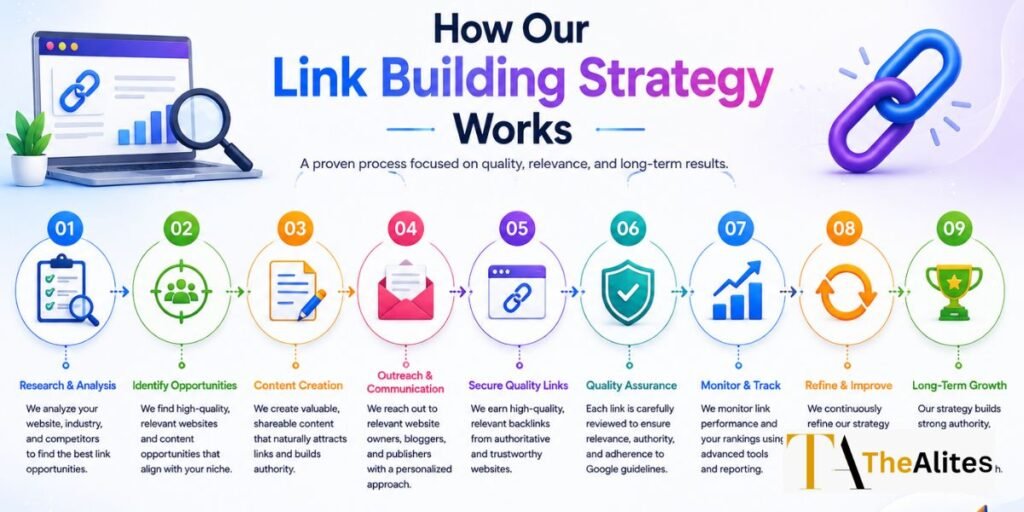
Our process begins with understanding your website, industry, competitors, audience, and existing authority profile. We then identify realistic opportunities based on relevance and quality rather than promising an arbitrary number of placements.
The strategy may involve several different forms of legitimate authority development depending on your business and market:
- Digital PR and editorial outreach
- Resource and content promotion
- Industry-relevant outreach
- Original research promotion
- Expert-led content opportunities
- Relevant business and professional citations
- Competitor backlink analysis
Each campaign is adapted to the website rather than following a fixed list of backlink sources.
Link Building and Your Wider SEO Strategy
Links should not operate independently from the rest of your SEO campaign.
Technical problems can prevent important pages from being crawled or indexed properly. Weak content can make outreach difficult. Poor internal linking can prevent authority from flowing effectively between important pages. A website that lacks clear topical organisation may also struggle to turn individual backlinks into broader authority.
This is why our SEO Services approach connects authority development with technical, content, keyword, and on-page optimisation.
Our SEO Audit Services can help identify weaknesses before a link campaign begins, while technical improvements and content optimisation create a stronger destination for the authority being earned.
A backlink is only one part of the equation. The page receiving that link must also provide an excellent experience for the people who arrive there.
What Makes a Backlink Worth Pursuing?
Not every backlink deserves the same level of attention. A useful link should make sense in the context where it appears and provide a genuine reason for a reader to visit the destination page.
For Australian businesses, relevance can exist at several levels. A website may be relevant because it operates within the same industry, serves a similar audience, covers the Australian market, or publishes information closely related to your expertise. The strongest opportunities are usually those where the relationship between the referring page and your content feels natural.
At TheAlites, we assess potential opportunities from a broader perspective rather than relying on a single third-party metric. Domain metrics can help with research, but they should never be treated as a substitute for relevance, editorial quality, or genuine usefulness.
How We Evaluate Link Opportunities
A backlink should not be accepted simply because a website has a high third-party authority score. A more useful evaluation considers the complete context of the opportunity.
Before recommending a link opportunity, we consider:
Topical Relevance
Does the website, publication, or specific page relate to the business, industry, audience, or subject being discussed?
Editorial Context
Would the link make sense within the surrounding content if the SEO benefit did not exist?
Audience Relevance
Could the referring website introduce the business to people who may genuinely benefit from its products, services, research, or expertise?
Source Quality
Is the website maintained, useful, trustworthy, and created for a real audience?
Placement
Would the link appear naturally within relevant editorial content, a useful resource, or another legitimate context?
Traffic Potential
Could the placement generate relevant referral visitors rather than existing only as an SEO metric?
Link Intent
Was the opportunity created because the resource is useful, or does the opportunity appear to exist mainly to manipulate rankings?
Commercial Relationship
If payment, sponsorship, advertising, or another commercial relationship is involved, can the link be appropriately qualified?
Third-party metrics such as Domain Rating, Domain Authority, or similar scores can be useful for research, but they should not be treated as Google ranking scores. A lower-metric website with strong topical relevance and a genuine audience may be more valuable than a high-metric website with no meaningful relationship to the business.
The objective is to build a backlink profile that makes sense when viewed as part of the entire business and its online reputation.
Australian Link Building Requires Local Understanding
A business targeting Australia should not automatically pursue links from any website with a high authority score. The geographic relevance of a source can be important when your business depends on Australian customers.
For example, an Australian professional services company may benefit from being referenced by relevant Australian business publications, industry organisations, local resources, professional communities, or authoritative websites serving its target audience.
Local relevance can help reinforce the connection between your brand and the market you serve. It also creates opportunities to reach real Australian audiences rather than acquiring links that exist only for SEO purposes.
Our Australian campaigns therefore consider the relationship between your business, target locations, industry, audience, and potential referring sources before outreach begins.
Digital PR as an Alternative to Traditional Link Building
Modern authority building increasingly overlaps with digital PR.
Instead of asking websites to publish links simply because you want backlinks, digital PR focuses on creating stories, research, insights, data, and expert opinions that journalists and publishers may genuinely want to cover.
An Australian business might publish original industry research, contribute expert commentary to a current topic, release useful statistics, or develop a unique resource that attracts media attention. When publishers choose to reference that material, links can become a natural result of the coverage.
This approach can build more than backlinks. It can increase brand awareness, introduce your business to new audiences, and establish your organisation as a knowledgeable source within its industry.
Ethical Outreach vs Manipulative Link Building
The difference between legitimate outreach and link manipulation is important.
Ethical outreach starts with relevance and value. A publisher is approached because its audience could genuinely benefit from the resource being offered. Manipulative outreach, on the other hand, often focuses on obtaining links regardless of context or usefulness.
Google’s spam policies specifically identify practices such as buying or selling links for ranking purposes, excessive link exchanges, automated link creation, and certain large-scale article campaigns that exist primarily to manipulate rankings as link spam.
Our strategy avoids tactics designed solely to manufacture ranking signals. We focus on building relationships, promoting useful resources, and earning references that have a legitimate reason to exist.
Dofollow, Nofollow, Sponsored, and UGC Links
Not every external link carries the same relationship or purpose. Understanding link attributes is important when managing paid placements, sponsored content, and user-generated links.
Regular Links
A normal editorial link does not need a special rel attribute when there is no reason to qualify the relationship. It can provide useful context and help users discover relevant information.
Nofollow Links
The rel="nofollow" attribute can be used when you do not want to associate your site with the linked page or when the relationship requires qualification.
Sponsored Links
Google recommends rel="sponsored" for links that are advertisements or paid placements. This helps communicate the commercial relationship clearly.
UGC Links
The rel="ugc" attribute is intended for links within user-generated content, such as forum posts and comments. Depending on the situation, nofollow can also be used.
The important point is that link attributes should reflect the actual relationship between the websites. Paid or sponsored links should not be created primarily to pass ranking credit. Google explicitly identifies paid links intended to manipulate rankings as a form of link spam.
Anchor Text Should Help the Reader
Anchor text is the clickable text used for a link. It provides context about the destination page and can help both users and search engines understand the relationship between two pages.
However, repeatedly forcing exact-match commercial keywords into backlinks can create an unnatural link profile. Google recommends descriptive and concise anchor text while cautioning against excessive keyword stuffing.
Our approach is therefore focused on natural context. Anchor text should describe the destination appropriately and fit the surrounding sentence rather than being inserted simply because a particular keyword has search volume.
This principle also applies to your internal links. When connecting this page with related resources such as Technical SEO Services, the anchor should make sense to the reader and accurately describe where the link leads.
Link Exchanges: Why More Is Not Always Better
A genuine relationship between two businesses may naturally result in websites linking to one another. However, deliberately creating excessive link exchanges for the purpose of manipulating rankings is a different matter.
Google lists excessive link exchanges among examples of link spam.
For this reason, we don’t build campaigns around artificial “you link to me and I’ll link to you” arrangements. Instead, we look for independent reasons for websites to reference useful resources.
A link should stand on its own as a valuable connection rather than existing because two websites agreed to exchange ranking signals.
Competitor Backlink Analysis
Your competitors can reveal useful information about the online landscape in your industry.
A competitor backlink analysis does not mean copying every link another website has acquired. Some competitor links may be irrelevant, low quality, or connected to tactics that you would not want for your own website.
Instead, we look for patterns and opportunities. We examine which types of content attract references, which publications discuss the industry, which resources competitors are being cited for, and where genuine gaps may exist.
This research can help identify opportunities for stronger content, better digital PR campaigns, and relevant outreach.
How to Build a Natural Backlink Profile
A natural backlink profile develops from different legitimate sources and relationships rather than from a fixed formula.
A business may naturally receive links from:
- Industry publications
- News and media websites
- Professional organisations
- Business associations
- Relevant resource pages
- Partners and suppliers
- Research publications
- Educational resources
- Local Australian websites
- Expert interviews
- Digital PR coverage
- Useful industry guides
- Original data and research
There is no universal percentage for how many links should use branded, URL, generic, or descriptive anchor text. Trying to manufacture a specific anchor-text ratio can encourage unnatural behaviour.
Instead, anchor text should describe the destination naturally and fit the surrounding sentence. Google recommends concise, relevant, descriptive anchor text and cautions against keyword stuffing.
A healthy strategy therefore focuses on earning useful references from different relevant contexts rather than trying to engineer an artificial backlink pattern.
Link Building Quality Assessment
Before pursuing a potential backlink, we consider several contextual factors.
| Factor | What We Look For |
|---|---|
| Relevance | Does the website or page relate to your industry or audience? |
| Context | Does the link make sense within the surrounding content? |
| Editorial Value | Is there a genuine reason for the publisher to reference you? |
| Audience | Could the source introduce your business to relevant users? |
| Quality | Is the website maintained and useful to its audience? |
| Placement | Is the link naturally integrated rather than artificially inserted? |
| Intent | Does the opportunity have value beyond manipulating rankings? |
No single metric determines whether a backlink is valuable. We consider the complete context before recommending an opportunity.
Link Building and Off-Page SEO
Link building is an important component of off-page optimisation, but Off-Page SEO is broader than backlinks alone.
Brand mentions, digital PR, reputation, relationships, and visibility across relevant online communities can all contribute to a stronger overall presence. A business that is consistently recognised as a useful and trustworthy source has a stronger foundation than one that focuses exclusively on accumulating links.
This is why our Off-Page SEO Services approach considers authority from a wider perspective. Link acquisition is part of the strategy, not the entire strategy.
Recovering Lost or Broken Backlinks
Existing authority can sometimes be overlooked.
Websites change URLs, remove pages, update their content, or redesign their structures. As a result, valuable backlinks may point to pages that no longer exist or may become disconnected from the most relevant resource.
A backlink audit can identify these situations and reveal opportunities to recover useful references where appropriate.
The process may involve redirecting an outdated URL to the correct destination, contacting a publisher when a relevant resource has changed, or improving the destination page so that an existing reference becomes useful again.
This is one reason ongoing SEO Audit Services can be valuable for established websites. SEO is not only about acquiring new opportunities; it is also about protecting and improving the assets you already have.
How Broken Link Building Works
Broken link building is a relevance-focused outreach method that can help improve useful resources on other websites.
The process generally involves four steps.
1. Find Relevant Broken Links
Identify reputable websites, resource pages, guides, and publications within your industry that contain outdated or broken links.
2. Understand the Missing Resource
Review the original context and determine what information the broken link was intended to provide. This helps ensure that any suggested replacement is genuinely relevant.
3. Create or Identify a Better Resource
If your website already contains a suitable resource, it may be appropriate to suggest it. If not, a genuinely useful resource may need to be created first.
4. Contact the Website Owner
The outreach should explain the broken link and provide the relevant replacement as a helpful suggestion. The objective is to improve the publisher’s resource rather than demand a backlink.
Broken link building works best when the replacement resource is highly relevant and genuinely useful. Sending generic outreach to hundreds of unrelated websites simply because they contain broken links is not a sustainable strategy.
Link Building Should Follow Your Website’s Priorities
A common mistake is building links to whichever page is easiest to promote.
The better approach is to understand which pages actually matter to the business. A high-value service page, original research resource, comprehensive guide, or strategically important category may deserve greater attention than a low-priority page.
Our campaigns therefore connect authority development with your broader SEO objectives. The pages receiving attention should have a clear purpose within your website architecture and a realistic opportunity to benefit from increased visibility.
This ensures link building contributes to business growth rather than becoming an isolated monthly activity.
How Link Building Fits into a Complete SEO Strategy
A sustainable SEO campaign requires several systems working together.
For that reason, link acquisition works best alongside On-Page SEO Services, Technical SEO Services, content optimisation, and strategic keyword research.
When these elements support one another, your website becomes stronger as a whole rather than relying on backlinks as a shortcut to rankings.
A Practical Link Building Example
Consider an Australian professional-services company competing for commercially valuable search terms.
The business already has useful service pages, but its website has limited external recognition compared with established competitors. Instead of purchasing a large number of backlinks, the campaign could focus on creating a resource that provides information other businesses and publishers can genuinely use.
The strategy might look like this:
Business research
↓
Identify a topic with strong audience interest
↓
Create an original industry report or research resource
↓
Optimise the resource for users and search intent
↓
Identify relevant Australian publications and industry websites
↓
Conduct personalised outreach
↓
Promote the research through appropriate channels
↓
Earn editorial mentions and relevant references
↓
Monitor referral traffic, referring domains, visibility, and conversions
The important point is that the campaign has a reason to exist beyond acquiring links. The research provides value first, while outreach helps the resource reach publishers and audiences that may find it useful.
Actual results will vary depending on competition, content quality, website authority, industry interest, outreach quality, and other SEO factors. No responsible agency should guarantee a fixed number of backlinks or a specific ranking position from a link-building campaign.
What Should a Link Building Campaign Actually Achieve?
A successful link building campaign should contribute to more than a backlink report. The real objective is to strengthen your website’s position within its industry by increasing its visibility, credibility, referral opportunities, and ability to be discovered by relevant audiences.
For an Australian business, this could mean being referenced by an industry publication, gaining exposure through a respected Australian resource, earning coverage for original research, or having useful content cited by websites that serve the same audience.
The value of a campaign therefore depends on the quality of opportunities it creates rather than the number of links delivered in a monthly report.
At TheAlites, we focus on building a link profile that supports the wider business strategy. We look at where your website currently stands, where competitors are earning attention, which pages deserve greater visibility, and what assets can realistically attract genuine references.
Measuring Link Building Without Chasing Vanity Metrics
SEO reporting can become misleading when a campaign focuses only on metrics that look impressive.
A large number of backlinks may sound positive, but it doesn’t automatically mean that those links are relevant, useful, or contributing to business growth. Likewise, third-party authority metrics can be helpful for research, but they are not Google ranking scores.
A better reporting system connects link acquisition with meaningful SEO and business outcomes.
| KPI | Why It Matters |
|---|---|
| Referring Domains | Shows how many distinct websites reference your brand |
| Relevant Referrals | Indicates whether links can bring useful audiences |
| Organic Visibility | Helps assess broader search performance |
| Referral Traffic | Measures visitors arriving through external links |
| Assisted Conversions | Shows whether referral visitors contribute to conversions |
| Brand Mentions | Indicates growing recognition within your market |
| Target Page Performance | Helps identify whether important pages are gaining visibility |
These metrics provide a more complete picture of authority development than simply counting backlinks.
How Long Does Link Building Take?
There is no responsible way to promise that a specific number of backlinks will produce a specific ranking within a fixed number of days.
SEO performance depends on many variables, including competition, website quality, content relevance, technical health, existing authority, search demand, and the strength of competing websites.
Link building is therefore best treated as a cumulative process. As useful resources are created, promoted, referenced, and discovered by relevant audiences, the website can gradually develop a stronger presence within its industry.
TheAlites focuses on sustainable progress rather than artificial deadlines. We establish realistic objectives, monitor performance, identify new opportunities, and refine the strategy as evidence becomes available.
What We Avoid in Link Building
Protecting your website is just as important as building authority.
A campaign that produces hundreds of questionable links may create unnecessary risk and provide little lasting value. Google currently identifies several manipulative link practices as link spam, including buying or selling links for ranking purposes, excessive link exchanges, automated link creation, low-quality directory links, and low-value content created mainly to manipulate links.
Our strategy avoids building campaigns around these tactics.
We also don’t believe that every website needs the same backlink profile. A national Australian brand, a local professional service provider, an eCommerce company, and a technology business may naturally earn links from very different sources.
A healthy strategy should reflect the business rather than forcing every client into the same backlink template.
Why Generic Guest Posting Isn’t a Complete Strategy
Guest contributions can have legitimate marketing value when they provide useful information to a relevant audience. The problem begins when large-scale articles are created primarily to place optimized links rather than to help readers.
Google specifically includes certain large-scale article campaigns and advertorial or guest-post links created primarily to manipulate rankings within its examples of link spam.
This doesn’t mean every guest contribution is automatically bad. Context, editorial purpose, quality, relevance, and how the link is qualified all matter.
Our approach is to look for genuine publishing opportunities where the content has value independently of the backlink. If a contribution wouldn’t be useful to the publication’s readers without the link, it probably isn’t a strong opportunity.
Building Links to the Right Pages
Not every page on your website needs an external backlink.
A campaign should identify the pages that can contribute most to your business and search strategy. These might include an important service page, a research study, a detailed industry guide, a useful resource, or a piece of original data.
Once these assets are identified, we consider how they fit within your wider website architecture.
This is particularly important for a site such as TheAlites, where supporting services can strengthen a central SEO Services topic. Links from relevant resources can help users discover deeper information while your internal linking connects related pages together.
Google also recommends using descriptive and relevant anchor text for internal links and ensuring important pages can be reached through links from other relevant pages.
Internal Links and External Links Work Differently
External backlinks and internal links should not be treated as the same thing.
External links can introduce your website to new audiences and provide references from other domains. Internal links help users and search engines navigate your own website and understand relationships between your pages.
For example, an article discussing authority development may naturally reference your Technical SEO Services page when explaining how technical problems can affect a website’s ability to benefit from organic search.
The anchor should be descriptive and fit naturally within the sentence. Google recommends concise, relevant anchor text and specifically advises against cramming keywords into links.
This is particularly important for your authority-site structure because internal links should help users move logically from broad topics to specialised services.
A Complete Link Building Workflow
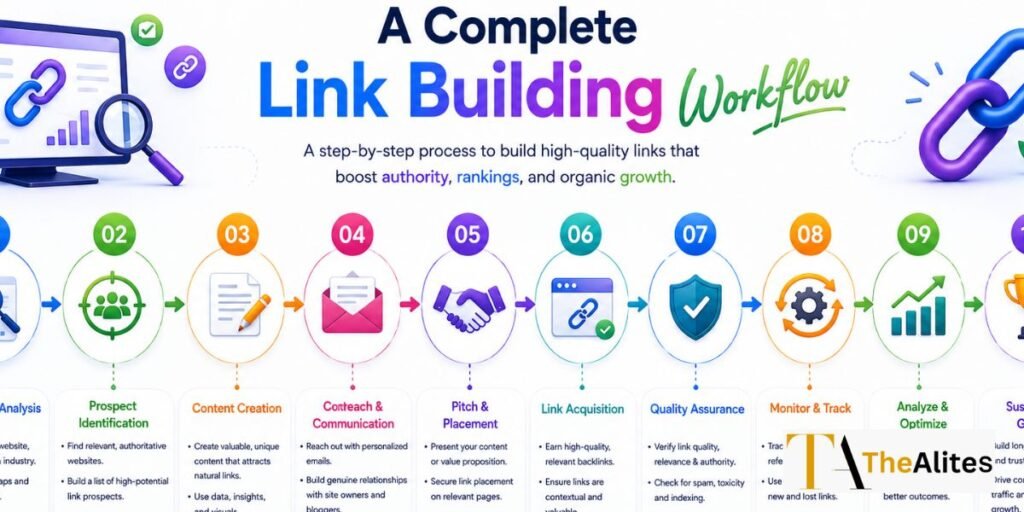
A professional campaign should have a clear process from research through measurement. The exact workflow will vary according to the business, but a typical campaign can include:
- Website and backlink profile analysis
- Competitor and industry research
- Content asset evaluation
- Link opportunity identification
- Publisher and website qualification
- Outreach and relationship development
- Content promotion
- Link and mention monitoring
- Performance reporting
- Ongoing strategy refinement
The process should remain flexible. If research shows that a particular type of opportunity is not producing meaningful results, the strategy should change rather than continuing simply because it was part of the original plan.
Link Building vs Other SEO Activities
Link building is powerful, but it shouldn’t be treated as a replacement for other SEO work.
| SEO Activity | Primary Purpose |
|---|---|
| On-Page SEO | Improve relevance, content structure, and page experience |
| Technical SEO | Improve crawling, indexing, and technical performance |
| Keyword Research | Understand what audiences search for |
| Content Strategy | Build useful topical coverage |
| Link Building | Develop external authority and discovery opportunities |
| Local SEO | Improve visibility for location-based searches |
| International SEO | Support visibility across countries and languages |
The strongest campaigns connect these activities rather than treating them as separate silos.
For businesses that need a broader strategy, our SEO Audit Services can identify where technical, content, on-page, and authority improvements should be prioritised.
Why Australian Businesses Need a Long-Term Authority Strategy
Australian search markets can be highly competitive, particularly for commercially valuable services and products. Competing only by publishing more pages is rarely enough when established businesses already have strong websites, recognised brands, and years of online authority.
A long-term authority strategy gives businesses another way to become visible within their industry.
This does not mean trying to replicate the backlink profile of a major competitor. Instead, it means developing assets, relationships, expertise, and visibility that make your own organisation worth referencing.
For Australian companies, local industry relevance can also make the strategy more meaningful. A reference from a website that serves the same Australian market may create both SEO and audience value.
Link Building and AI Search
Search is evolving beyond traditional blue-link results. Search systems increasingly need to understand topics, entities, context, relationships, and the credibility of information sources.
This makes the purpose of link building even more important.
Rather than trying to create large numbers of keyword-rich backlinks, businesses should focus on becoming sources that people and publishers have a genuine reason to reference.
Useful strategies include:
- Publishing original research and data
- Demonstrating genuine industry expertise
- Creating detailed and useful resources
- Building relationships with relevant publications
- Earning editorial mentions
- Maintaining accurate business information
- Supporting important claims with credible sources
- Creating content that provides original analysis rather than rewriting existing pages
Google’s Search Essentials emphasise helpful, reliable, people-first content and warn against tactics designed to manipulate search rankings. Google’s spam policies also cover manipulative link practices, including buying or selling links for ranking purposes, excessive link exchanges, automated link creation, and low-value content created primarily to manipulate ranking signals.
For this reason, a future-focused authority strategy should concentrate on genuine usefulness, expertise, relevance, and relationships rather than treating backlinks as isolated ranking tokens.
The goal is simple: build a brand and resource library that deserves to be discovered, referenced, and trusted.
Link Building Tools We Use for Research and Analysis
Professional link building requires more than sending outreach emails. Research and analysis help identify relevant opportunities, understand competitors, monitor acquired links, and evaluate the health of an existing backlink profile.
Depending on the campaign, commonly used tools include:
| Tool | Primary Use |
|---|---|
| Google Search Console | Monitor search performance, links, indexing, and website issues |
| Google Analytics 4 | Measure referral traffic and user behaviour |
| Ahrefs | Backlink research, referring domains, competitor analysis, and link opportunities |
| Semrush | Backlink analysis, competitor research, and authority monitoring |
| Screaming Frog | Website crawling, broken links, redirects, and technical analysis |
| Moz Link Explorer | Backlink and link-profile research |
| Google Search | Find relevant publications, resource pages, organisations, and industry opportunities |
Tools support decision-making, but software metrics should never replace human judgment. A backlink opportunity should still be evaluated for relevance, context, quality, audience, and legitimate purpose.
TheAlites uses research and analysis to understand the opportunity landscape before recommending a link-building approach.
Why Choose TheAlites for Link Building Services?
At TheAlites, we don’t see link building as a race to collect the largest possible number of backlinks.
We see it as a process of building relationships between valuable content, relevant websites, and real audiences. Our campaigns are developed around the individual business, its industry, its competitors, its target market, and its existing digital authority.
For Australian businesses, we place particular emphasis on relevance and market context. The objective is to develop a natural authority profile that supports your broader SEO strategy rather than creating an artificial collection of links.
Our Mission
Our mission is to help Australian businesses build online authority through SEO strategies that provide genuine value to users.
We believe sustainable SEO should never depend on shortcuts. Strong websites are built through useful content, technical quality, clear information architecture, meaningful relationships, and trustworthy digital signals.
Our Link Building Services are therefore designed to complement these foundations. We help businesses identify opportunities to earn meaningful references while continuously improving the content and website assets that make those references valuable.
The ultimate goal isn’t simply to obtain more links. It’s to build a website and brand that people, publishers, customers, and search systems have a genuine reason to trust.
Link Building Audit Checklist
Before launching or reviewing a link-building campaign, use the following checklist:
Website Foundation
- Is the target page indexable?
- Does the page satisfy search intent?
- Is the content genuinely useful?
- Does the page have clear internal links?
- Does the website have a technically sound foundation?
Backlink Profile
- Which websites currently link to you?
- Which referring domains are relevant?
- Are there obvious low-quality or manipulative patterns?
- Have important backlinks been lost?
- Are valuable brand mentions currently unlinked?
Competitor Research
- Which publications reference competitors?
- What types of content attract competitor links?
- Are there industry resources competitors are being cited in?
- Which opportunities are genuinely relevant to your business?
Outreach Quality
- Is the publisher relevant?
- Does the audience match your target market?
- Is there a genuine reason for the link?
- Is the outreach personalised?
- Does the proposed resource provide value without the backlink?
Link Qualification
- Is the link editorial or commercial?
- If paid or sponsored, is it appropriately qualified?
- Are user-generated links marked appropriately?
- Is keyword stuffing being avoided?
Measurement
- Are referring domains being monitored?
- Is referral traffic being measured?
- Are target pages improving?
- Are organic visibility and conversions being tracked?
- Are brand mentions increasing?
A strong campaign should be reviewed regularly rather than judged only by the number of backlinks acquired.
Frequently Asked Questions
What is Link Building?
Link building is the process of developing opportunities for other websites to reference your website through links. Effective link building focuses on relevance, usefulness, editorial value, and sustainable authority rather than simply increasing backlink numbers.
Are backlinks still important in 2026?
Links remain one way Google discovers pages and evaluates relevance, but they are only one part of a broader search system. A successful SEO strategy should combine useful content, technical quality, good website architecture, user experience, and legitimate authority signals.
What makes a backlink high quality?
A valuable backlink is typically relevant to the topic or audience, placed in a meaningful context, and earned for a legitimate reason. The referring website should provide genuine value rather than existing primarily to sell or distribute SEO links.
How many backlinks does my website need?
There is no universal number. The appropriate level of authority varies by industry, competition, website history, content quality, and business objectives. Chasing a fixed backlink number can encourage low-quality tactics.
Are paid backlinks safe?
Paid advertising and sponsorship can be legitimate, but links that are paid for should be appropriately qualified. Google recommends rel="sponsored" for paid or sponsored links and also accepts rel="nofollow" in relevant situations.
Is guest posting still useful?
Guest contributions can provide marketing and audience value when they are genuinely useful and relevant. However, publishing large volumes of low-value guest posts primarily to obtain ranking-manipulation links can fall under Google’s link-spam policies.
Does link building improve rankings immediately?
No. SEO results depend on many factors, and there is no guaranteed timeframe for ranking improvements. Link acquisition should be viewed as a long-term authority-building activity rather than an instant ranking technique.
Can Link Building help Australian businesses?
Yes. Relevant Australian publications, industry resources, professional organisations, and other appropriate sources can help businesses increase exposure to audiences within their target market while developing a stronger online presence.
Should I combine Link Building with other SEO services?
Yes. Link building generally works best when supported by strong technical foundations, useful content, keyword research, on-page optimisation, and a logical internal linking structure.
Build Stronger Website Authority with Link Building Services
Strong link building is not about collecting the largest number of backlinks. It is about earning relevant references that support your content, brand, audience, and wider SEO strategy.
At TheAlites, we develop link-building campaigns around your industry, competitors, target market, existing authority, and most valuable website pages. From digital PR and content promotion to competitor research, link reclamation, and relevant outreach, our focus remains on sustainable authority rather than artificial link volume.
Ready to strengthen your website’s authority?
Contact TheAlites to discuss a link-building strategy designed around your business goals.
References
- Google Search Essentials — Google Search Central
- Google Spam Policies for Web Search — Google Search Central
- SEO Link Best Practices — Google Search Central
- Qualify Outbound Links for Google — Google Search Central
- Creating Helpful, Reliable, People-First Content — Google Search Central
These resources guide crawlable links, descriptive anchor text, link qualification, helpful content, and practices that can negatively affect search visibility.