
Introduction
This article has been written by a Senior TheAlites’ Technical SEO Specialist with extensive experience in website audits, Core Web Vitals optimization, structured data implementation, crawlability improvements, and technical website architecture. Every recommendation has been reviewed to ensure it aligns with Google’s latest Technical SEO best practices.
A beautifully designed website and high-quality content alone are no longer enough to rank well on Google. If search engines cannot properly crawl, understand, and index your website, even the best content may never reach your target audience.
This is where Technical SEO Services become essential.
Technical SEO is the foundation of every successful SEO strategy. It ensures that your website is fast, secure, mobile-friendly, easy to crawl, and optimized according to Google’s latest search standards. Without a strong technical foundation, your On-Page SEO Services and Off-Page SEO Services efforts cannot achieve their full potential.
In 2026, Google uses advanced AI systems to evaluate websites based on user experience, crawlability, page performance, structured data, mobile usability, and overall website quality. Technical SEO helps search engines access your content efficiently while providing visitors with a smooth and reliable browsing experience.
At TheAlites, we provide comprehensive Technical SEO Services that identify and resolve hidden issues affecting your website’s performance. From improving Core Web Vitals and fixing crawl errors to implementing structured data and optimizing site architecture, our goal is to create a technically strong website that supports long-term organic growth.
Whether you operate a local business, an eCommerce store, a SaaS platform, or an enterprise website, our technical SEO solutions help search engines understand your website better while improving visibility, rankings, and user satisfaction.
What Are Technical SEO Services?
Technical SEO refers to the process of optimizing your website’s technical infrastructure so search engines can efficiently crawl, index, and understand your content.
Unlike On-Page SEO Services, which focus on content optimization, keyword placement, and user intent, Technical SEO focuses on the backend elements that influence search performance.
Similarly, improving your authority with Off-Page SEO Services helps build your website’s authority through backlinks, digital PR, and brand mentions. Technical SEO ensures your website is technically capable of benefiting from those authority signals.
Professional Technical SEO typically includes:
- Website crawl analysis
- Indexability optimization
- XML Sitemap optimization
- Robots.txt configuration
- Website architecture
- URL optimization
- HTTPS implementation
- Core Web Vitals optimization
- Page speed improvements
- Mobile usability
- Structured data (Schema)
- Canonical tag optimization
- Redirect management
- Broken link fixes
- Duplicate content prevention
- Crawl budget optimization
- Internal linking improvements
Technical SEO creates a strong foundation that allows every other SEO strategy to perform more effectively.
Why Technical SEO Matters in 2026
Google’s search algorithms continue to evolve, placing greater emphasis on website quality and user experience.
A technically optimized website helps search engines:
- Discover your pages faster.
- Understand your content more accurately.
- Index important pages correctly.
- Deliver a better user experience.
- Trust your website’s technical quality.
Without proper Technical SEO, businesses may experience:
- Poor indexing
- Slow page speed
- Crawl errors
- Duplicate content
- Lower rankings
- Reduced organic traffic
- Higher bounce rates
- Lost revenue opportunities
Technical SEO is no longer optional—it’s an essential part of sustainable search engine optimization.
Google’s Technical SEO Priorities in 2026
Google’s goal is to deliver the most helpful and reliable search results.
To achieve this, it evaluates several technical factors that influence both usability and crawl efficiency.
| Technical SEO Factor | Why It Matters | Business Benefit |
|---|---|---|
| Crawlability | Helps Google discover website pages efficiently | Faster indexing of new content |
| Indexability | Ensures important pages appear in search results | Higher organic visibility |
| Mobile-First Indexing | Google primarily evaluates the mobile version of websites | Better mobile rankings and user experience |
| Core Web Vitals | Measures page speed, responsiveness, and visual stability | Improved engagement and lower bounce rates |
| HTTPS Security | Protects user data and builds trust | Increased credibility and search trust |
| Structured Data | Helps search engines understand page content | Better chances of earning rich results |
Below are some of Google’s highest-priority technical SEO considerations.
Crawlability
Before Google can rank a page, it must first discover it.
Crawlability refers to how easily search engine bots can access and navigate your website.
Factors affecting crawlability include:
- Website architecture
- Internal linking
- XML Sitemap
- Robots.txt
- Broken links
- Redirect chains
A well-structured website makes it easier for search engines to find important pages quickly.
Indexability
Not every crawled page is indexed.
Indexability determines whether Google includes a page in its search results.
Common indexing issues include:
- Noindex tags
- Duplicate pages
- Canonical errors
- Blocked resources
- Thin content
- Soft 404 pages
Resolving these issues ensures your valuable pages can appear in search results.
Mobile-First Indexing
Google primarily evaluates the mobile version of your website.
A mobile-friendly website should offer:
- Responsive layouts
- Fast loading times
- Readable text
- Easy navigation
- Mobile-friendly forms
- Proper touch spacing
A poor mobile experience can negatively affect both rankings and user engagement.
Page Experience
Technical SEO isn’t only about search engines—it also focuses on visitors.
Google considers several page experience signals, including:
- Fast loading pages
- Visual stability
- Responsive interactions
- Secure browsing
- Mobile usability
Improving these elements creates a better experience for users while supporting stronger organic performance.
Website Security
HTTPS has become the standard for modern websites.
Secure websites help protect user information while building trust with both visitors and search engines.
Every professional website should use SSL encryption and maintain a secure browsing environment.
Core Elements of Professional Technical SEO
Successful Technical SEO combines multiple optimization strategies working together.
Rather than focusing on one issue, every important technical element should support overall website performance.
1. Website Architecture
A clear website structure helps both users and search engines navigate your content.
An effective website architecture should:
- Organize pages logically.
- Keep important pages within a few clicks.
- Support easy navigation.
- Improve crawl efficiency.
- Strengthen internal linking.
A well-organized structure also helps distribute authority throughout your website.
2. XML Sitemap
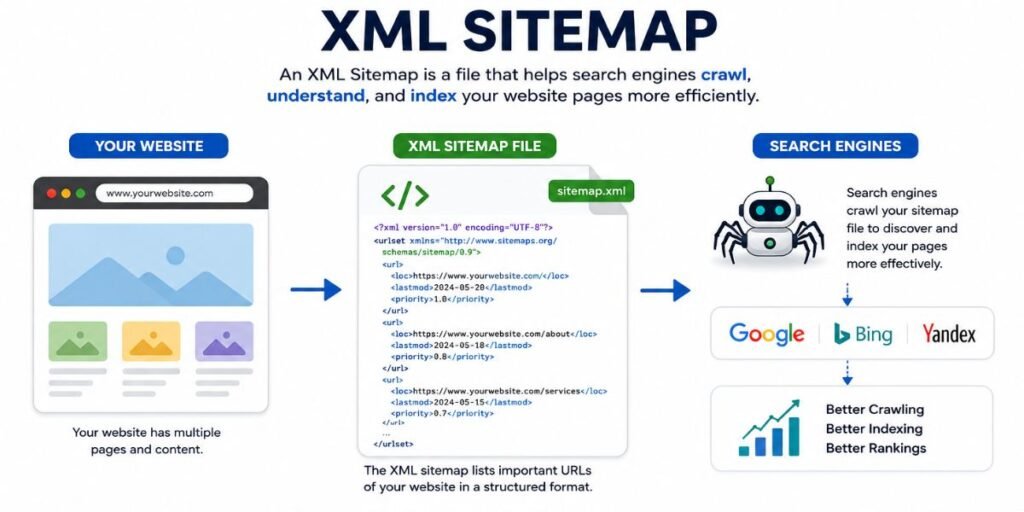
An XML Sitemap acts as a roadmap for search engines.
It tells Google which pages exist and helps search engines discover new or updated content more efficiently.
A properly maintained sitemap should:
- Include important pages.
- Exclude unnecessary URLs.
- Update automatically when content changes.
- Be submitted through Google Search Console.
3. Robots.txt
The robots.txt file provides instructions about which areas of your website search engine crawlers should or should not access.
Proper configuration helps:
- Reduce unnecessary crawling.
- Protect private sections.
- Improve crawl efficiency.
- Prevent indexing of unwanted pages.
Incorrect settings, however, can accidentally block important content from search engines.
4. URL Structure
Clean, descriptive URLs improve usability and help search engines understand page topics.
For example:
Recently, our Technical SEO team audited an e-commerce website with over 8,000 indexed pages. After fixing crawl errors, improving Core Web Vitals, implementing proper canonical tags, and optimizing internal linking, the website experienced a significant improvement in crawl efficiency and organic visibility within a few months.
5. Canonical Tags
Duplicate content can confuse search engines.
Canonical tags indicate the preferred version of a page when similar content exists.
This helps consolidate ranking signals and prevents duplicate content issues from affecting search visibility.
6. Internal Linking
Internal links connect related pages throughout your website.
A strong internal linking strategy helps:
- Improve crawlability.
- Distribute authority.
- Increase user engagement.
- Support topical relevance.
For example, this page naturally connects with our On-Page SEO Services and Off-Page SEO Services, allowing both users and search engines to understand how these SEO disciplines work together.
A well-planned internal linking strategy strengthens your website’s overall SEO architecture.
Core Web Vitals
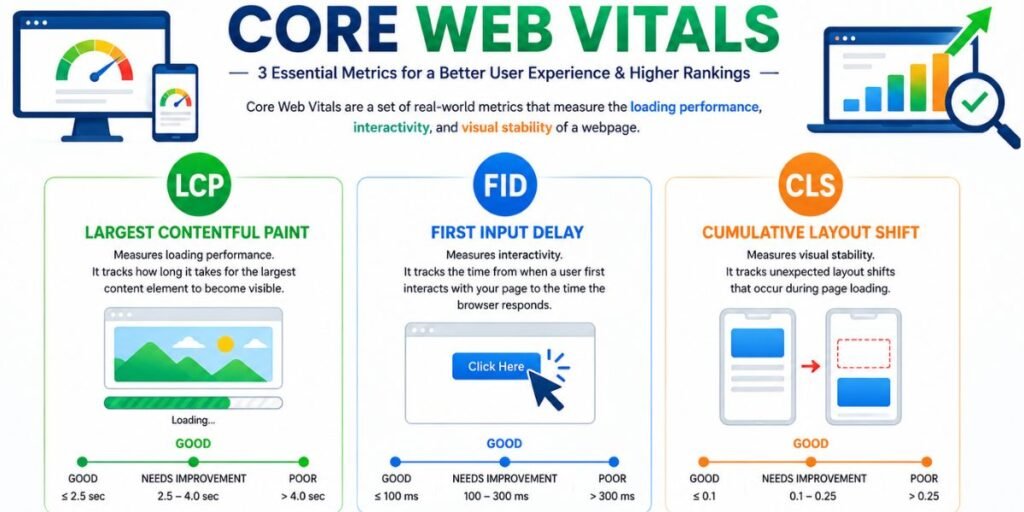
Core Web Vitals are Google’s user experience metrics that measure how visitors interact with your website. These signals help determine whether your pages provide a fast, stable, and responsive experience.
We regularly monitor website performance using Google PageSpeed Insights and Google Search Console’s Core Web Vitals Report. These tools provide valuable insights into loading speed, responsiveness, and visual stability, allowing us to identify performance issues and implement improvements that align with Google’s recommended standards.
Improving Core Web Vitals not only enhances user satisfaction but can also support stronger search performance.
| Core Web Vitals | What It Measures | Recommended Target | Optimization Tips |
|---|---|---|---|
| Largest Contentful Paint (LCP) | Loading performance | Under 2.5 seconds | Compress images, improve server response, and enable caching |
| Interaction to Next Paint (INP) | User interaction responsiveness | Under 200 ms | Reduce JavaScript, optimize third-party scripts |
| Cumulative Layout Shift (CLS) | Visual stability | Below 0.1 | Set image dimensions, reserve space for dynamic content |
Largest Contentful Paint (LCP)
LCP measures how quickly the main content of a page becomes visible.
To improve LCP:
- Optimize server response time
- Compress images
- Use modern image formats like WebP
- Remove unnecessary render-blocking resources
- Enable browser caching
A fast-loading page creates a better first impression and reduces abandonment.
Interaction to Next Paint (INP)
INP measures how quickly your website responds when users interact with buttons, forms, menus, or links.
A responsive website feels faster and provides a smoother browsing experience.
Ways to improve INP include:
- Reduce JavaScript execution
- Optimize third-party scripts
- Improve server response
- Minimize unnecessary browser tasks
Cumulative Layout Shift (CLS)
CLS measures visual stability.
Unexpected layout movement during page loading creates frustration and may cause users to click the wrong element.
Reduce layout shifts by:
- Setting image dimensions
- Reserving space for advertisements
- Avoiding dynamically inserted content above existing elements
- Optimizing fonts
Page Speed Optimization
Website speed directly impacts user experience, engagement, and conversions.
Slow websites often experience:
- Higher bounce rates
- Lower conversions
- Reduced user satisfaction
- Fewer pages per session
Professional page speed optimization involves compressing images, enabling browser caching, reducing unnecessary code, implementing lazy loading, and using a CDN. Together, these improvements reduce loading times and create a smoother browsing experience.
A faster website creates a better experience for both users and search engines.
Structured Data (Schema Markup)
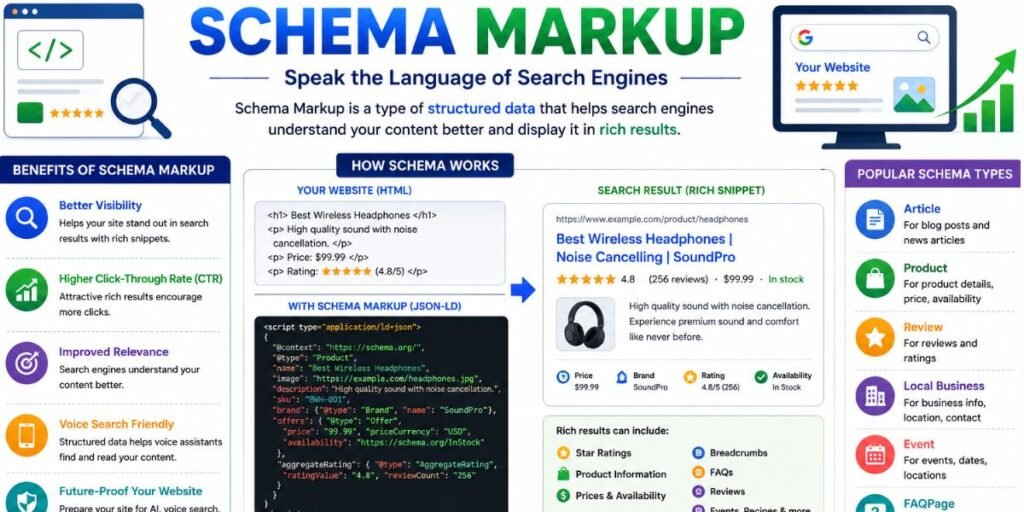
After implementing structured data, we validate every schema using Google’s Rich Results Test to ensure it is correctly configured and eligible for enhanced search results. Proper validation helps search engines better understand your content and reduces the likelihood of structured data errors.
Although visitors rarely see structured data, search engines use it to generate enhanced search results and improve content understanding.
Common schema types include:
- Organization Schema
- Service Schema
- Article Schema
- FAQ Schema
- Breadcrumb Schema
- Local Business Schema
- Review Schema
Proper schema implementation increases your chances of earning rich results while improving semantic understanding.
Organization Schema
Organization Schema helps search engines understand important business information, including:
- Business name
- Logo
- Website
- Contact information
- Social profiles
This contributes to stronger brand recognition across search engines.
Service Schema
Service Schema provides additional context about the services your business offers.
For example:
- Technical SEO Services
- Learn more about our On-Page SEO Services
- Off-Page SEO Services
- SEO Audits
- AI SEO Services
Structured service data helps search engines better understand your offerings.
Breadcrumb Schema
Breadcrumbs improve navigation for both users and search engines.
Example:
Home → SEO Services → Technical SEO Services
This structure clearly communicates page hierarchy while improving crawl efficiency.
FAQ Schema
Adding FAQ Schema helps search engines understand frequently asked questions and may improve visibility in search results.
It also enhances user experience by presenting clear answers to common queries.
HTTPS & Website Security
Security is a fundamental component of Technical SEO.
Visitors expect websites to protect their personal information.
Professional security practices include:
- SSL certificates
- HTTPS implementation
- Secure hosting
- Malware monitoring
- Regular software updates
- Firewall protection
Secure websites build trust while supporting better search performance.
Redirect Management
Redirects help guide users and search engines when URLs change.
The most common redirect types include:
301 Redirect
A permanent redirect that transfers most SEO value from the old page to the new page.
Ideal for:
- Website migrations
- URL changes
- Deleted pages
302 Redirect
A temporary redirect is used when content will return to its original location.
Using the correct redirect type prevents indexing issues and preserves ranking signals.
Broken Link Optimization
Broken links create a poor user experience and waste crawl resources.
Regularly checking for:
- Broken internal links
- Broken external links
- Redirect loops
- Missing pages
helps maintain a healthy website.
Fixing broken links improves navigation while strengthening technical quality.
Duplicate Content Management
Duplicate content occurs when multiple URLs display identical or nearly identical information.
Common causes include:
- URL parameters
- Printer-friendly pages
- HTTP and HTTPS versions
- WWW and non-WWW versions
- Category duplication
Technical SEO resolves these issues through canonical tags, redirects, and proper indexing controls.
Crawl Budget Optimization
Large websites must use their crawl budget efficiently.
Search engines allocate limited resources when crawling websites.
Improving crawl budget involves:
- Removing unnecessary pages
- Fixing redirect chains
- Eliminating duplicate content
- Improving internal linking
- Maintaining a clean website architecture
Efficient crawling helps search engines discover important pages more frequently.
JavaScript SEO
Modern websites often rely heavily on JavaScript.
However, excessive or poorly implemented JavaScript can delay content rendering and reduce crawl efficiency.
Professional JavaScript SEO focuses on:
- Server-side rendering where appropriate
- Reducing unnecessary scripts
- Improving rendering speed
- Ensuring important content remains crawlable
This allows search engines to access valuable content without unnecessary delays.
Image Optimization
Images contribute significantly to page performance.
Technical image optimization includes:
- Compressing images
- Using WebP or AVIF formats
- Descriptive filenames
- Meaningful alt text
- Lazy loading
- Responsive image sizing
Optimized images improve loading speed, accessibility, and overall user experience.
Technical SEO Tools Comparison
Professional Technical SEO relies on the right tools to analyze and improve website performance. Popular tools like Google Search Console, Google PageSpeed Insights, Screaming Frog, Ahrefs, Semrush, and GTmetrix each provide unique insights into crawl errors, indexing issues, site speed, backlinks, and overall website health. Choosing the right combination of tools helps create a more effective SEO strategy.
AI Search Optimization
Search continues to evolve beyond traditional ranking systems.
AI-powered search experiences evaluate websites based on content quality, technical reliability, structured data, and overall authority.
Technical SEO supports AI visibility by ensuring:
- Well-organized website architecture
- Clean structured data
- Fast performance
- Mobile usability
- Accurate indexing
- Clear page hierarchy
A technically strong website makes it easier for AI-powered search systems to understand and recommend your content.
Our Technical SEO Process
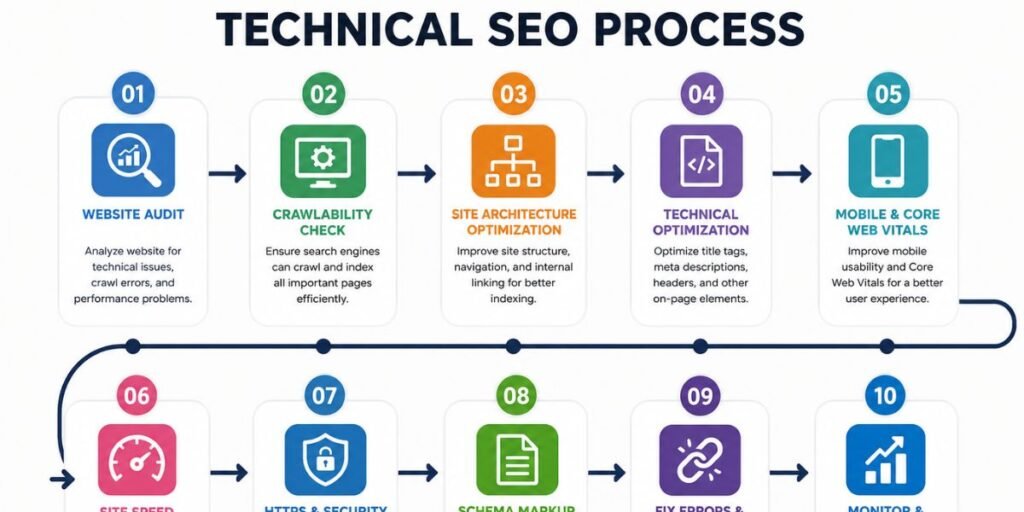
Every successful optimization campaign begins with a detailed technical evaluation.
At TheAlites, we follow a structured process designed to identify hidden technical issues and improve your website’s long-term performance.
Step 1: Technical Website Audit
To perform a comprehensive Technical SEO audit, our team uses industry-leading tools such as Google Search Console, Screaming Frog SEO Spider, Ahrefs, and Semrush. These tools help us identify crawl errors, indexing issues, broken links, duplicate content, orphan pages, and technical performance problems. By combining data from multiple trusted platforms, we can develop an accurate optimization strategy tailored to your website.
Example Case Study: Improving an eCommerce Website’s Technical SEO
A growing eCommerce business was struggling with slow page speed, duplicate product URLs, and indexing issues. Although the website had quality products and content, many important pages were not appearing consistently in Google Search.
Our Technical SEO team conducted a full website audit and identified crawl errors, duplicate content, missing canonical tags, and poor Core Web Vitals. We optimized the XML sitemap, implemented canonical tags, improved internal linking, compressed images, and enhanced page loading performance.
Within the following months, the website showed noticeable improvements in crawl efficiency and user experience.
| Metric | Before Optimization | After Optimization |
|---|---|---|
| Indexed Pages | 2,150 | 3,420 |
| Core Web Vitals Status | Needs Improvement | Good |
| Average Page Load Time | 4.9 Seconds | 2.1 Seconds |
| Crawl Errors | 186 | 18 |
| Organic Traffic | Increased steadily | Higher than the previous period |
Key Takeaway: Fixing technical issues allowed search engines to crawl and index more valuable pages, improving the website’s overall organic visibility.
Technical SEO Audit Template
A Technical SEO audit provides a structured approach to identifying website issues that may affect search performance. A typical audit includes website architecture, crawlability, indexing status, page speed, Core Web Vitals, structured data, mobile responsiveness, broken links, redirects, duplicate content, HTTPS security, and internal linking. Following a detailed audit template ensures no critical optimization opportunities are overlooked.
Step 2: Technical SEO Strategy
Based on our findings, we develop a customized optimization roadmap tailored to your business goals and website requirements.
Every recommendation prioritizes long-term growth rather than temporary improvements.
Step 3: Technical Implementation
Our team implements technical improvements, including:
- XML Sitemap optimization
- Robots.txt configuration
- Canonical optimization
- Schema implementation
- URL improvements
- HTTPS verification
- Internal linking enhancements
- Page speed optimization
Each update follows Google’s latest technical SEO best practices.
Step 4: Testing & Validation
After implementation, we carefully test every improvement.
This includes validating:
- Structured data
- Mobile usability
- Core Web Vitals
- Crawlability
- Indexability
- Website security
Testing ensures every optimization functions correctly before ongoing monitoring begins.
Step 5: Continuous Monitoring
Technical SEO requires regular maintenance.
We continuously monitor:
- Crawl performance
- Search Console reports
- Index coverage
- Performance metrics
- Core Web Vitals
- Technical errors
Regular monitoring helps identify new issues before they affect rankings.
Common Technical SEO Reports
Regular reporting helps track your website’s technical health and measure SEO progress over time. Common Technical SEO reports include crawl error reports, index coverage reports, Core Web Vitals performance, page speed analysis, structured data validation, broken link reports, XML sitemap status, mobile usability reports, and Google Search Console performance insights. These reports help businesses make informed optimization decisions.
What’s Included in Our Technical SEO Services?
Our Technical SEO solutions include:
- Comprehensive technical SEO audit
- Website architecture optimization
- XML Sitemap optimization
- Robots.txt configuration
- Core Web Vitals optimization
- Page speed improvements
- Mobile SEO optimization
- HTTPS & security review
- Schema markup implementation
- Canonical tag optimization
- Redirect management
- Broken link fixes
- Duplicate content resolution
- Crawl budget optimization
- JavaScript SEO improvements
- Image optimization
- Internal linking recommendations
- Ongoing technical monitoring
| Service | What We Do | Expected Outcome |
|---|---|---|
| Technical SEO Audit | Identify crawl, indexing, and performance issues | Clear optimization roadmap |
| XML Sitemap Optimization | Update and submit sitemap to Google | Faster content discovery |
| Robots.txt Optimization | Control crawler access | Better crawl efficiency |
| Core Web Vitals Optimization | Improve speed and user experience | Higher engagement and rankings |
| Schema Markup | Add structured data for better understanding | Rich search results |
| Internal Linking Optimization | Strengthen page connections | Improved crawlability and authority |
| Redirect & Canonical Management | Resolve duplicate content and redirect issues | Preserved link equity |
| Ongoing Technical Monitoring | Track website health regularly | Long-term SEO performance |
Every recommendation is designed to create a technically sound website that supports both On-Page SEO Services and Off-Page SEO Services, providing a strong foundation for sustainable organic growth.
Technical SEO Checklist
A successful Technical SEO strategy starts with a comprehensive checklist. This includes checking website crawlability, indexability, XML sitemaps, robots.txt, Core Web Vitals, mobile usability, HTTPS security, structured data, internal linking, and page speed. Regular technical audits help identify issues early and keep your website optimized according to Google’s latest best practices.
Common Technical SEO Mistakes That Hurt Rankings
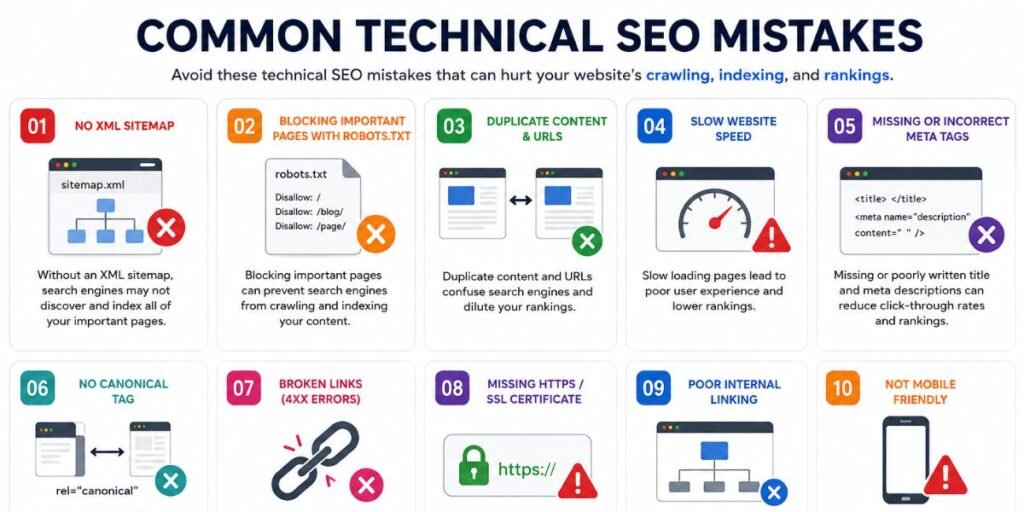
Even businesses with excellent content can struggle to rank if technical SEO issues prevent search engines from properly crawling, indexing, and understanding their websites.
| Technical SEO Issue | Impact on SEO | Recommended Solution |
|---|---|---|
| Slow Website Speed | Higher bounce rate and lower rankings | Optimize images, caching, CDN, and code |
| Poor Mobile Optimization | Reduced mobile visibility | Use responsive design and improve mobile usability |
| Broken Internal Links | Crawl errors and poor navigation | Regularly audit and fix broken links |
| Duplicate Content | Confuses search engines | Use canonical tags and proper redirects |
| Missing Schema Markup | Missed rich result opportunities | Implement relevant structured data |
| Incorrect Redirects | Loss of link equity and crawl issues | Use direct 301 redirects where appropriate |
| Blocked Important Pages | Pages may not appear in Google Search | Review robots.txt and noindex settings |
| Ignoring Core Web Vitals | Poor user experience | Continuously monitor and optimize performance |
Here are some of the most common technical SEO mistakes to avoid.
1. Slow Website Speed
A slow-loading website creates a poor user experience and can reduce engagement, conversions, and search visibility.
Common causes include:
- Uncompressed images
- Poor-quality hosting
- Excessive JavaScript
- Large CSS files
- Too many third-party scripts
Improving page speed should always be a priority.
2. Poor Mobile Optimization
Since Google uses mobile-first indexing, your website must provide an excellent experience on smartphones and tablets.
Common issues include:
- Small text
- Clickable elements are placed too close together
- Horizontal scrolling
- Slow mobile loading
- Poor responsive design
A mobile-friendly website benefits both users and search engines.
3. Broken Internal Links
Broken links waste crawl budget and frustrate visitors.
Regular website audits help identify:
- 404 pages
- Broken navigation links
- Missing images
- Invalid redirects
Keeping internal links healthy improves both usability and crawl efficiency.
4. Duplicate Content
Multiple versions of the same content confuse search engines.
Examples include:
- HTTP and HTTPS versions
- WWW and non-WWW URLs
- Parameter-based URLs
- Similar service pages
Canonical tags and proper redirects help eliminate duplicate content problems.
5. Poor Internal Linking Structure
Internal links help search engines discover pages and understand relationships between topics.
For example, your Technical SEO Services page should naturally connect with your:
- SEO Services
- On-Page SEO Services
- Off-Page SEO Services
- Keyword Research Services
- Explore our SEO Audit Services
- AI SEO Services
A strong internal linking strategy distributes authority across your website while improving user navigation.
6. Missing Structured Data
Without structured data, search engines have fewer signals to understand your website.
Schema markup helps explain:
- Your business
- Services
- FAQs
- Articles
- Breadcrumbs
- Reviews
This improves semantic understanding and can increase eligibility for rich search results.
7. Ignoring Core Web Vitals
Core Web Vitals measure loading performance, responsiveness, and visual stability.
Ignoring these metrics can negatively affect user experience.
Regular performance testing helps maintain a technically healthy website.
8. Incorrect Redirects
Using multiple redirect chains or the wrong redirect type slows crawling and reduces efficiency.
Whenever possible:
- Use direct 301 redirects.
- Remove unnecessary redirect chains.
- Update internal links to point directly to the final destination.
9. Blocking Important Pages
Improper robots.txt settings or accidental “noindex” directives can prevent valuable pages from appearing in search results.
Always review indexing settings before publishing website changes.
10. Treating Technical SEO as a One-Time Task
Technical SEO requires ongoing maintenance.
As your website grows, regular monitoring helps identify new issues before they affect rankings.
Routine audits ensure your website continues meeting Google’s evolving standards.
Benefits of Professional Technical SEO Services
A technically optimized website provides long-term advantages for both search engines and users.
Better Crawlability
Search engines can discover important pages more efficiently, helping new and updated content appear in search results faster.
Improved Indexing
Technical SEO ensures your most valuable pages are properly indexed while preventing duplicate or unnecessary pages from consuming crawl resources.
Higher Search Rankings
A technically healthy website supports stronger organic visibility by removing barriers that limit search performance.
Faster Website Performance
Optimized loading speed improves user satisfaction while increasing engagement and conversion opportunities.
Better User Experience
Visitors stay longer on websites that load quickly, function smoothly, and provide intuitive navigation.
Stronger Website Security
HTTPS implementation and secure website practices build trust with both users and search engines.
Better Support for On-Page & Off-Page SEO
Technical SEO acts as the foundation that allows your On-Page SEO Services and Off-Page SEO Services strategies to perform at their highest potential.
Sustainable Long-Term Growth
Instead of chasing temporary ranking improvements, Technical SEO creates a stable foundation that supports long-term organic success.
Example Case Study: Technical SEO for a Local Service Business
A local service provider had well-written content but was experiencing low organic visibility due to technical issues such as broken internal links, slow mobile performance, and missing structured data.
After performing a comprehensive technical audit, our team optimized the website architecture, implemented Organization and Service Schema, fixed redirect issues, improved mobile usability, and enhanced Core Web Vitals.
These technical improvements helped search engines better understand the website while creating a faster and more user-friendly experience.
| Improvement Area | Before | After |
|---|---|---|
| Mobile Performance | Fair | Excellent |
| Structured Data | Not Implemented | Fully Implemented |
| Broken Internal Links | Multiple Issues | Resolved |
| Crawlability | Limited | Improved |
| User Engagement | Lower | Improved Session Duration |
Key Takeaway: A technically optimized website provides a stronger foundation for content, helping improve user experience and supporting long-term SEO growth.
Technical SEO KPIs
Measuring the right Key Performance Indicators (KPIs) is essential for evaluating Technical SEO success. Important KPIs include Core Web Vitals scores, website loading speed, crawl errors, indexed pages, mobile usability, organic traffic, page indexing rate, server response time, broken link count, and overall website health score. Monitoring these metrics regularly helps maintain a technically optimized website that supports long-term organic growth.
Why Choose TheAlites for Technical SEO Services?
At TheAlites, we believe every successful SEO campaign starts with a technically strong website.
Our team combines technical expertise with modern SEO strategies to ensure your website meets Google’s latest search standards.
Comprehensive Technical Audits
We identify hidden technical issues affecting crawlability, indexing, website speed, and overall performance.
Customized SEO Solutions
Every website is different.
Our recommendations are tailored to your business, industry, and technical requirements rather than using generic checklists.
White-Hat SEO Approach
We follow Google’s recommended best practices and implement sustainable optimization strategies designed for long-term success.
Performance-Focused Optimization
Our goal is not only better rankings but also faster websites, improved usability, and stronger user engagement.
Transparent Reporting
You’ll receive clear insights into:
- Technical improvements completed
- Website health
- Performance metrics
- Future optimization opportunities
Long-Term Partnership
Technical SEO continues evolving as search engines improve.
We’re committed to helping your website remain optimized, secure, and competitive for years to come.
Industries We Serve
Our Technical SEO Services support businesses across multiple industries, including:
- eCommerce
- Healthcare
- Technology
- SaaS
- Real Estate
- Finance
- Education
- Legal Services
- Travel & Hospitality
- Manufacturing
- Professional Services
- Automotive
- Home Services
- Startups
- Local Businesses
Every industry has unique technical challenges, and our strategies are customized to meet your specific business goals.
Frequently Asked Questions
What are Technical SEO Services?
Technical SEO Services improve your website’s backend structure, making it easier for search engines to crawl, index, and understand your content while enhancing overall performance.
Why is Technical SEO important?
Technical SEO provides the foundation for successful organic growth by improving website speed, security, crawlability, and user experience.
What’s the difference between Technical SEO and On-Page SEO?
Technical SEO focuses on your website’s infrastructure, while On-Page SEO Services optimize content, keywords, headings, and user intent.
How is Technical SEO different from Off-Page SEO?
Technical SEO improves your website itself, whereas Off-Page SEO Services build authority through backlinks, digital PR, reviews, and brand mentions.
How often should Technical SEO be performed?
A comprehensive technical audit should be conducted regularly, especially after major website updates, redesigns, or migrations.
Does page speed affect SEO?
Yes. Faster websites provide a better user experience and help search engines crawl pages more efficiently.
What is crawlability?
Crawlability refers to how easily search engines can access and navigate your website.
What is structured data?
Structured data (Schema Markup) provides additional information that helps search engines better understand your content and services.
Can Technical SEO improve conversions?
Yes. Faster page load times, better usability, and improved navigation often increase user engagement and conversion rates.
Why choose TheAlites?
TheAlites delivers customized Technical SEO strategies focused on long-term website performance, better rankings, and sustainable business growth.
Ready to Build a Technically Strong Website?
A successful SEO strategy starts with a solid technical foundation. Without proper crawlability, fast performance, secure infrastructure, and optimized website architecture, even the best content and strongest backlink profile may not achieve their full potential.
At TheAlites, our Technical SEO Services are designed to help businesses improve website health, strengthen search visibility, and create exceptional user experiences. Whether you need a complete technical audit, Core Web Vitals optimization, structured data implementation, or ongoing technical support, our team is ready to help your website perform at its best.
About the Author
TheAlites SEO Team consists of experienced SEO professionals specializing in Technical SEO, On-Page SEO, Off-Page SEO, website performance optimization, and search engine visibility. Our team follows Google’s latest Search Essentials and industry best practices to help businesses improve organic rankings, website performance, and long-term online growth.