
Introduction
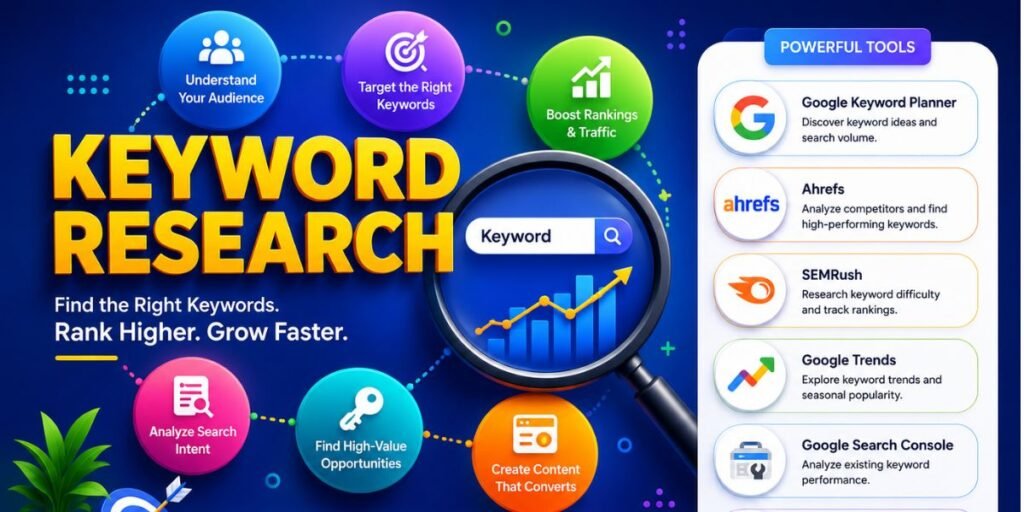
Ranking on Google is no longer about adding a few popular keywords to a webpage. Search engines have become much smarter, understanding user intent, context, entities, and overall content quality. In 2026, successful SEO begins with one critical step—keyword research.
Without proper keyword research, businesses often target the wrong audience, publish content that never ranks, or compete for highly competitive terms with little chance of success. On the other hand, a well-planned keyword strategy helps you attract the right visitors, answer their questions, and convert them into customers.
At TheAlites, our Keyword Research Services go beyond simply generating keyword lists. We identify high-value search opportunities based on user intent, competition, business goals, and search behavior. Every keyword recommendation is supported by data, helping you create content that aligns with what your audience is actually searching for.
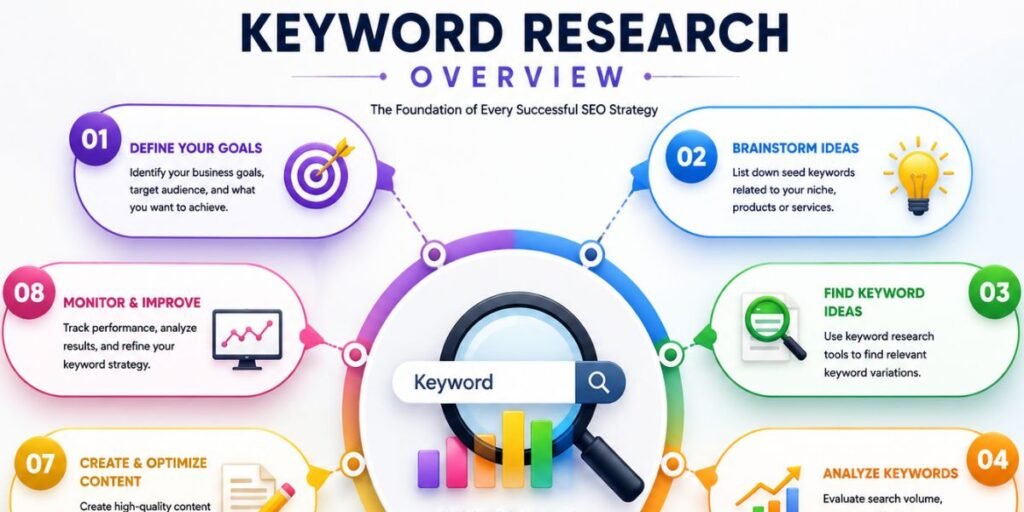
Whether you’re launching a new website, improving existing content, or expanding your SEO strategy, professional keyword research provides the roadmap for long-term organic growth. It also strengthens every aspect of your SEO campaign, including On-Page, Technical, and Off-Page SEO Services, ensuring that all your optimization efforts work toward the same goal.
What Are Keyword Research Services?
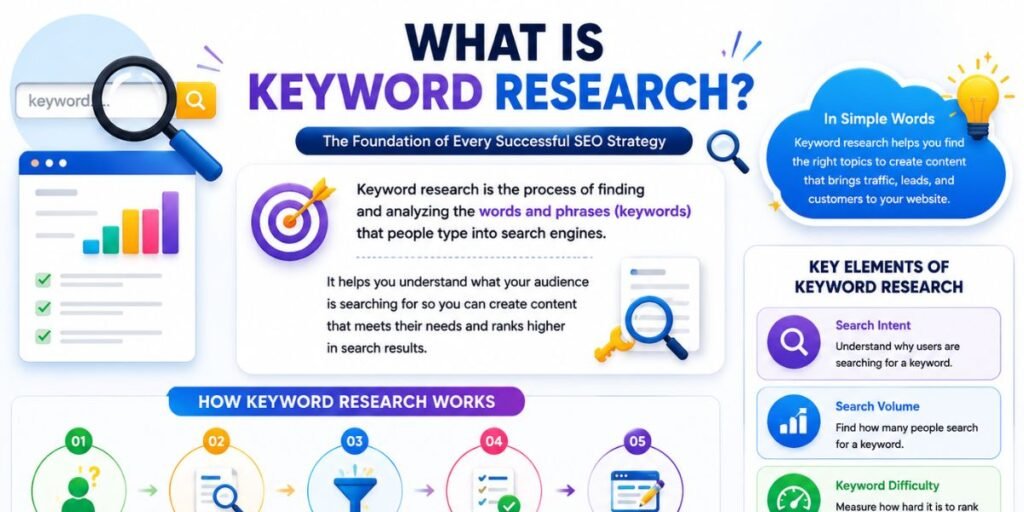
Keyword Research Services involve identifying the words, phrases, and search queries your target audience uses when looking for products, services, or information online. Instead of guessing what people might search for, keyword research relies on real search data to uncover valuable opportunities.
Professional keyword research isn’t just about finding keywords with high search volume. It focuses on understanding why users search, what they expect to find, and how your business can provide the most relevant answer.
A comprehensive keyword research strategy helps businesses:
- Discover topics customers are actively searching for.
- Understand the search intent behind every query.
- Identify low-competition opportunities.
- Target keywords that support business goals.
- Build content that answers real user questions.
Rather than chasing thousands of random keywords, we focus on building a keyword strategy that attracts qualified visitors who are more likely to engage with your business.
Why Keyword Research Matters in 2026
The way people search has changed significantly over the last few years. Users now ask longer, more conversational questions through Google, AI-powered search experiences, and voice assistants.
Google’s algorithms analyze much more than exact-match keywords. They evaluate context, topical relevance, semantic relationships, user satisfaction, and content quality before deciding which pages deserve higher rankings.
This means businesses need a smarter keyword strategy—one that focuses on solving problems instead of simply repeating keywords.
Effective keyword research helps you:
- Reach the right audience instead of chasing irrelevant traffic.
- Create content that matches user expectations.
- Improve organic visibility for multiple related searches.
- Increase qualified leads and conversions.
- Build long-term topical authority within your industry.
Without proper keyword research, even the best-designed website may struggle to achieve consistent organic growth.
How Google Understands Keywords Today
Modern search engines no longer rely solely on exact keyword matching. Instead, they use advanced language processing and AI systems to understand the meaning behind a search query.
For example, someone searching for “best SEO company for small businesses” may also expect information related to affordable SEO, local SEO, website optimization, and digital marketing solutions.
Google understands these relationships and rewards content that thoroughly answers the user’s intent.
Instead of creating separate pages for every minor keyword variation, businesses should focus on creating comprehensive content that naturally covers related concepts and user questions.
This is why keyword research has evolved from finding keywords to understanding topics.
Our Approach to Keyword Research
At TheAlites, we believe keyword research should support business growth—not just rankings.
Every keyword we recommend is selected based on three important questions:
Are people actually searching for it?
A keyword with no meaningful demand rarely delivers business value.
Does it match your business goals?
High traffic means very little if visitors are unlikely to become customers.
Can your website realistically compete?
Rather than targeting impossible keywords immediately, we identify opportunities that offer realistic growth while building authority over time.
This balanced approach creates sustainable SEO success instead of short-term traffic spikes.
Types of Keywords We Research
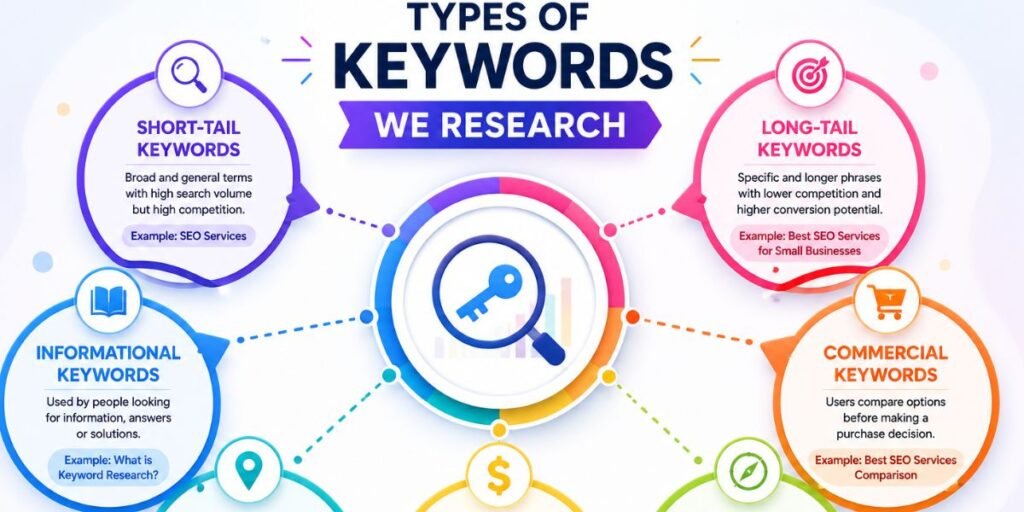
Different keywords serve different purposes within an SEO strategy. Understanding these categories helps create content that supports users throughout their buying journey.
Short-Tail vs Long-Tail Keywords
| Short-Tail Keywords | Long-Tail Keywords |
|---|---|
| Broad search queries | Specific search queries |
| Higher search volume | Lower but targeted search volume |
| Highly competitive | Lower competition |
| Lower conversion rate | Higher conversion potential |
| Best for brand awareness | Best for qualified leads |
Short-Tail Keywords
Short-tail keywords usually consist of one or two words and often have high search volume with intense competition.
Examples include:
- SEO Services
- Digital Marketing
- Keyword Research
While these keywords attract large audiences, they are generally more difficult to rank for.
Long-Tail Keywords
Long-tail keywords are longer and more specific search phrases.
Examples include:
- Keyword Research Services for Small Businesses
- Professional SEO Keyword Research Agency
- Best Keyword Research Services in Australia
Although search volume may be lower, long-tail keywords often attract visitors with stronger purchase intent and higher conversion potential.
Informational Keywords
These keywords are used by people looking to learn something before making a decision.
Examples include:
- What is keyword research?
- How does keyword research work?
- Why is keyword research important?
Informational content helps build trust and attracts users during the early stages of their journey.
Commercial Keywords
Commercial keywords indicate that users are comparing services or preparing to make a purchase.
Examples include:
- Best Keyword Research Services
- SEO Keyword Research Agency
- Professional Keyword Research Company
These keywords often lead to higher-quality leads.
Transactional Keywords
Transactional keywords show a strong intention to take action.
Examples include:
- Hire Keyword Research Experts
- Buy Keyword Research Services
- Keyword Research Agency Near Me
These searches typically have the highest conversion potential.
Understanding Search Intent
Search intent is one of the most important ranking factors in modern SEO. Every search query reflects a user’s objective. Google aims to display pages that best satisfy that objective.
Types of Search Intent
| Search Intent | User Goal | Best Content Type |
|---|---|---|
| Informational | Learn something | Blog Articles |
| Navigational | Visit a website | Homepage or Brand Page |
| Commercial | Compare options | Service Pages |
| Transactional | Take action | Landing Pages |
There are four primary types of search intent:
- Informational – The user wants to learn something.
- Navigational – The user is looking for a specific website or brand.
- Commercial – The user is comparing options before making a decision.
- Transactional – The user is ready to purchase or contact a business.
Understanding search intent helps create content that answers users’ questions more effectively, improving both rankings and engagement.
Keyword Mapping
Finding good keywords is only the first step. The next step is assigning each keyword to the most appropriate page.
Keyword mapping prevents multiple pages from competing for the same search terms while creating a clear website structure.
For example:
- SEO Services → Pillar Page
- On-Page SEO Services → Service Page
- Technical SEO Services → Service Page
- Off-Page SEO Services → Service Page
- Keyword Research Services → Service Page
Supporting blog articles can then target more specific long-tail keywords while linking back to these primary service pages.
A well-organized keyword map improves website structure, strengthens internal linking, and supports topical authority.
Case Study: How Strategic Keyword Research Improved Organic Visibility
Every keyword strategy should produce measurable business results. One of our recent SEO campaigns focused on identifying high-intent keywords, improving keyword mapping, and aligning content with user search intent.
After implementing the strategy, the website achieved stronger keyword visibility, improved organic traffic, and better rankings for its target services.
| Metric | Before | After |
|---|---|---|
| Ranking Keywords | (2 keywords) | (104 keywords) |
| Organic Traffic | ( 0 ) | (12k + ) |
| Top 10 Rankings | ( 0 ) | ( 20 ) |
| Qualified Leads | ( 2 ) | ( 50 + ) |
Semantic SEO & Entity-Based Keyword Research
Modern keyword research goes beyond individual words.
Google understands relationships between topics, businesses, products, and concepts. This means successful content should naturally include related terms, entities, and supporting topics rather than repeating the same keyword over and over.
For example, a page about Keyword Research Services may naturally discuss:
- Search intent
- Competitor analysis
- Topic clusters
- Content strategy
- Keyword mapping
- Semantic SEO
- Topical authority
- User experience
Covering these connected topics helps search engines understand your expertise while providing users with more complete and valuable information.
Our Keyword Research Process
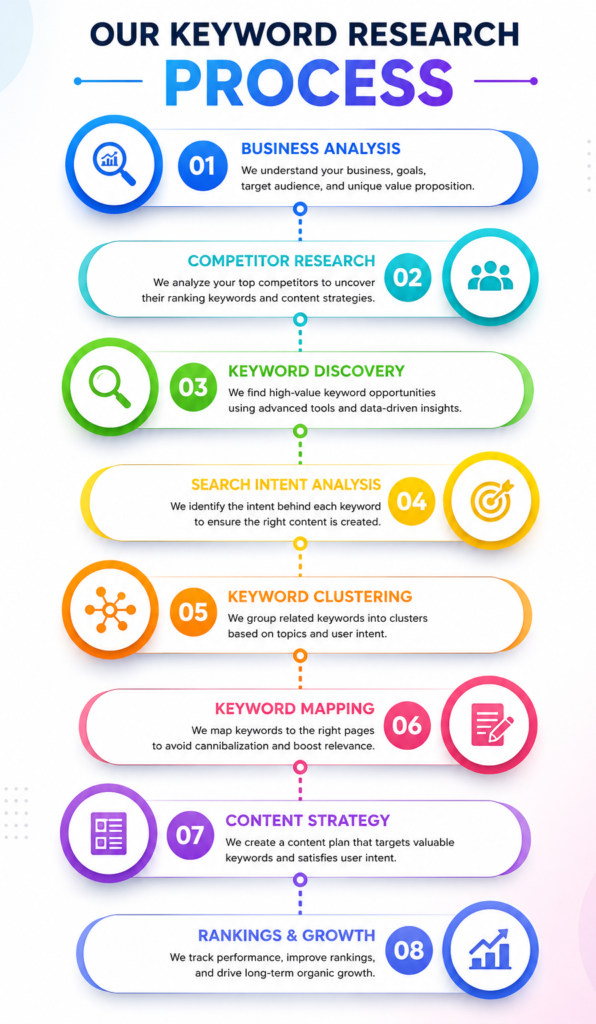
At TheAlites, keyword research is not about exporting thousands of keywords from a tool. It’s about understanding your audience, analyzing your competitors, and identifying opportunities that align with your business objectives.
Every business is different, which is why we develop customized keyword strategies instead of relying on generic keyword lists. Our process focuses on attracting qualified visitors who are more likely to become customers while supporting your long-term SEO growth.
Step 1: Understanding Your Business
Every successful keyword strategy begins with understanding your business.
Before researching keywords, we analyze:
- Your products and services
- Target audience
- Industry
- Geographic locations
- Business goals
- Current website performance
This helps us identify the types of searches that are most valuable for your business rather than simply targeting high-volume keywords.
Step 2: Competitor Keyword Analysis
Your competitors provide valuable insights into what works within your industry.
Instead of copying their strategy, we identify opportunities where your website can compete more effectively.
Our competitor analysis includes:
- Ranking keywords
- Top-performing pages
- Content gaps
- Competitor strengths
- Untapped keyword opportunities
- Search visibility
This research allows us to build a stronger keyword strategy while avoiding unnecessary competition.
Step 3: Search Intent Analysis
A keyword is only valuable if it matches the user’s intent.
For every keyword we identify, we determine:
- What the user wants.
- Which type of content does Google prefer?
- Whether the keyword is informational or commercial.
- How likely is it to generate qualified leads?
Understanding search intent helps create content that satisfies both users and search engines.
Step 4: Keyword Clustering
Rather than creating separate pages for every similar keyword, we group related keywords into topic clusters.
For example, instead of targeting:
- Keyword Research
- SEO Keyword Research
- Keyword Analysis
- SEO Keyword Analysis
On separate pages, we organize them under one comprehensive page supported by related content.
This approach strengthens topical authority while preventing keyword cannibalization.
Step 5: Keyword Mapping
Once keywords are grouped into logical clusters, we assign each keyword to the most appropriate page.
For example:
- SEO Services → Pillar Page
- Keyword Research Services → Primary Service Page
- Technical SEO Services → Service Page
- On-Page SEO Services → Service Page
- Off-Page SEO Services → Service Page
This structure creates a clear website hierarchy that supports both user navigation and search engine crawling.
Competitor Keyword Analysis
One of the fastest ways to discover valuable keyword opportunities is by studying websites that already rank well in your industry.
Competitor keyword analysis helps identify:
- Keywords driving competitor traffic
- Content topics you haven’t covered
- Pages earning backlinks
- Ranking opportunities with lower competition
- New content ideas
Instead of competing blindly, businesses can make informed SEO decisions based on real search data.
Local Keyword Research
Businesses targeting specific cities or regions need a localized keyword strategy.
Rather than focusing only on broad keywords, local SEO targets searches with geographic intent.
Examples include:
- SEO Agency in Sydney
- Technical SEO Services Melbourne
- Keyword Research Services Australia
- Local SEO Services Brisbane
Local keyword research helps attract nearby customers who are actively searching for your services.
AI-Powered Keyword Research
The way people search online continues to evolve with AI-powered search experiences.
Users increasingly ask detailed, conversational questions instead of typing short keyword phrases.
Modern keyword research, therefore, focuses on:
- Conversational searches
- Question-based keywords
- Long-tail searches
- Semantic relevance
- Entity relationships
- User intent
This approach improves visibility across both traditional search engines and AI-powered search platforms.
Content Gap Analysis
Many businesses overlook valuable keyword opportunities because they only focus on the content they already have.
Content gap analysis identifies important topics your competitors cover, but your website does not.
This process helps you:
- Discover missing content opportunities.
- Expand topical authority.
- Target additional search intent.
- Increase organic visibility.
- Build a stronger content strategy.
Content gap analysis often uncovers opportunities that generate long-term organic traffic with relatively lower competition.
Keyword Research Tools Comparison
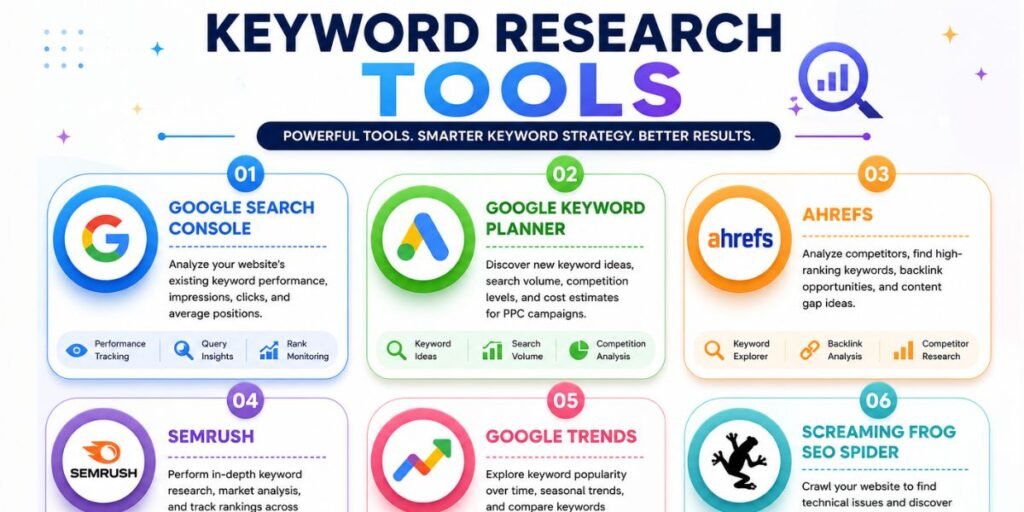
Professional keyword research combines multiple tools because no single platform provides every insight.
Some of the most widely used tools include:
| Tool | Primary Purpose |
|---|---|
| Google Search Console | Analyze existing keyword performance |
| Google Keyword Planner | Discover keyword ideas and search demand |
| Ahrefs | Competitor keyword and backlink research |
| Semrush | Keyword difficulty and market analysis |
| Google Trends | Seasonal trends and keyword popularity |
| Screaming Frog | Technical website auditing |
Each tool contributes different data, allowing SEO professionals to build more accurate keyword strategies.
Keyword Clustering for Topical Authority
Google increasingly rewards websites that cover an entire topic instead of publishing isolated articles.
Keyword clustering helps organize related topics into logical content groups.
For example:
SEO Services (Pillar Page)
↓
Technical SEO Services
↓
On-Page SEO Services
↓
Off-Page SEO Services
↓
Keyword Research Services
↓
Supporting Articles
This structure strengthens internal linking, improves user experience, and establishes your website as an authority within its niche.
What’s Included in Our Keyword Research Services?
Every business has different goals, so our keyword research strategies are tailored to your specific industry and audience.
Our services typically include:
- Comprehensive keyword research
- Competitor keyword analysis
- Search intent analysis
- Keyword clustering
- Keyword mapping
- Local keyword research
- Long-tail keyword research
- Commercial keyword identification
- Content gap analysis
- Topic cluster planning
- SEO content recommendations
- Internal linking opportunities
- Monthly keyword tracking
- Performance reporting
Our recommendations are designed to support not only Keyword Research Services, but also your Technical SEO Services, On-Page SEO Services, Off-Page SEO Services, and overall SEO Services strategy.
Keyword Research Checklist
Before finalizing a keyword strategy, we verify that every important factor has been considered.
Our checklist includes:
- Target audience identified
- Search intent analyzed
- Competitor research completed
- Primary keywords selected
- Secondary keywords identified
- Long-tail keywords included
- Topic clusters created
- Keyword mapping completed
- Internal linking opportunities planned
- Content priorities established
Following a structured checklist helps ensure every keyword contributes to a clear, measurable SEO strategy rather than becoming just another search term in a spreadsheet.
Common Keyword Research Mistakes to Avoid
Many businesses invest time and money in SEO but still fail to achieve consistent rankings because they make fundamental keyword research mistakes. Choosing the wrong keywords can attract irrelevant traffic, reduce conversions, and make it difficult to compete in search results.
Understanding these mistakes helps build a stronger SEO strategy from the beginning.
1. Targeting Only High-Volume Keywords
Many website owners believe that higher search volume automatically means better results. In reality, highly competitive keywords are often difficult to rank for, especially for newer websites.
A balanced strategy combines competitive keywords with long-tail and low-competition opportunities to generate sustainable traffic and qualified leads.
2. Ignoring Search Intent
A keyword may have thousands of monthly searches, but if it doesn’t match what users are looking for, it is unlikely to generate meaningful results.
For example, someone searching “What is keyword research?” wants educational content, while someone searching “Keyword Research Services” is more likely looking to hire an SEO agency.
Matching search intent is one of the most important ranking factors in modern SEO.
3. Keyword Stuffing
Repeating the same keyword excessively no longer improves rankings.
Google’s algorithms understand synonyms, related phrases, and semantic relationships. Instead of forcing keywords into every paragraph, the content should read naturally while covering the topic comprehensively.
4. Ignoring Long-Tail Keywords
Long-tail keywords often have lower competition and stronger buying intent.
Businesses that focus only on broad keywords miss valuable opportunities to attract highly targeted visitors who are ready to take action.
5. Publishing Content Without Keyword Mapping
Creating multiple pages targeting the same keyword confuses search engines and causes keyword cannibalization.
A proper keyword map ensures each page has a unique focus while supporting your overall website structure.
6. Forgetting Internal Linking
Keyword research should support your entire website—not individual pages.
For example, this page should naturally connect with your SEO Services, On-Page SEO, Technical SEO, and Off-Page SEO pages. Strategic internal linking helps search engines understand topical relationships and distributes authority across your website.
7. Never Updating Keyword Research
Search behavior changes over time. New trends, AI-powered search experiences, and evolving customer needs create fresh opportunities every year.
Reviewing and updating your keyword strategy regularly helps keep your content competitive and relevant.
Benefits of Professional Keyword Research Services
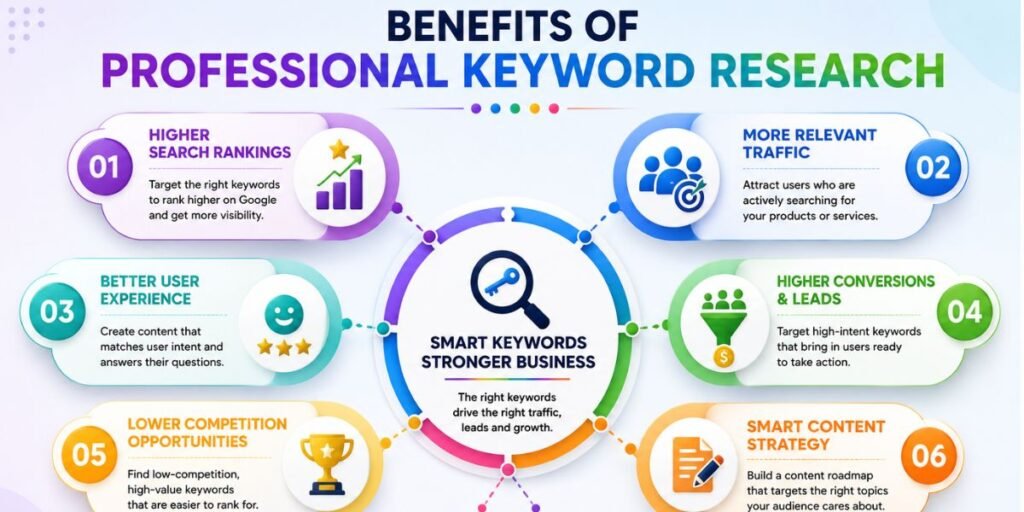
Professional keyword research provides much more than a list of search terms. It creates a strategic foundation that supports every stage of your SEO campaign.
Reach the Right Audience
Targeting keywords that align with user intent attracts visitors who are genuinely interested in your products or services, increasing the likelihood of engagement and conversions.
Improve Organic Rankings
A well-planned keyword strategy helps search engines understand your website’s relevance, making it easier to rank for valuable search queries over time.
Increase Qualified Traffic
Instead of chasing large amounts of untargeted traffic, keyword research focuses on attracting users who are more likely to become customers.
Strengthen Content Strategy
Knowing what your audience is searching for allows you to create valuable content that answers real questions and builds trust.
Support Topical Authority
Keyword research helps organize content into logical topic clusters. This strengthens your SEO Services pillar while supporting pages like Technical SEO Services, On-Page SEO Services, and Off-Page SEO Services through strategic internal linking.
Example:
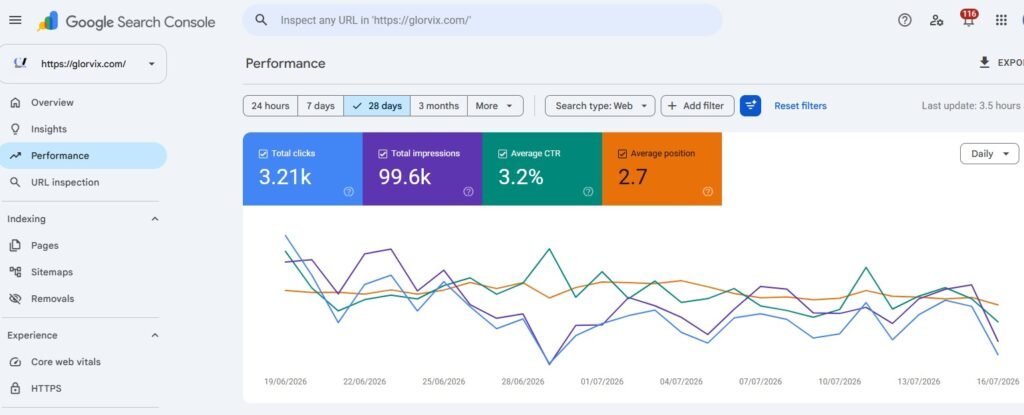
A well-planned keyword strategy can significantly improve search visibility when combined with quality content and technical optimization. For example, Glorvix.com has successfully targeted competitive SEO-related keywords in the USA by focusing on search intent, topical authority, and strategic keyword mapping. The ranking screenshot below demonstrates how a structured keyword strategy contributes to stronger organic visibility.
Improve ROI
Publishing content based on real search demand reduces wasted effort and increases the likelihood of generating long-term organic traffic and leads.
Keyword Research KPIs
Tracking performance helps measure whether your keyword strategy is delivering meaningful results.
Important KPIs include:
- Organic keyword rankings
- Qualified organic traffic
- Search visibility
- Click-through rate (CTR)
- Keyword ranking growth
- Conversion rate from organic search
- Top-performing landing pages
- Number of ranking keywords
- Share of voice
- Organic leads generated
Monitoring these metrics helps identify opportunities for continuous improvement.
Why Choose TheAlites for Keyword Research Services?
At TheAlites, we believe successful SEO starts with understanding people—not just keywords. Our keyword research strategies are designed to help businesses attract the right audience, create valuable content, and build sustainable search visibility.
Data-Driven Research
Every keyword recommendation is backed by search data, competitor analysis, and user intent rather than assumptions.
Customized Strategies
We don’t rely on generic keyword lists. Every strategy is tailored to your industry, business goals, and target audience.
Modern SEO Approach
Our research considers semantic SEO, topical authority, entity optimization, and AI-powered search trends to keep your website competitive in 2026 and beyond.
Complete SEO Integration
Keyword research is closely aligned with our Technical SEO Services, On-Page SEO Services, Off-Page SEO Services, SEO Audit Services, and Content Writing Services, ensuring every aspect of your SEO campaign works together.
Long-Term Growth
Our focus is on building sustainable organic growth through strategic planning, high-quality content, and continuous optimization.
References & Industry Resources
This guide is based on industry best practices and recommendations from trusted SEO resources.
- Google Search Essentials
- Google Search Central Documentation
- Google Keyword Planner
- Google Search Console Help
- Google Trends
- Ahrefs Blog
- Semrush Blog
- Moz Beginner’s Guide to SEO
Frequently Asked Questions
What are Keyword Research Services?
Keyword Research Services identify the search terms your target audience uses and help you create content that improves rankings, attracts qualified traffic, and supports business growth.
Why is keyword research important for SEO?
Keyword research ensures your website targets topics people are actively searching for while matching their intent and increasing your chances of ranking higher in search results.
How often should keyword research be updated?
It’s recommended to review your keyword strategy regularly, especially after major algorithm updates, changes in your industry, or shifts in customer search behavior.
What’s the difference between short-tail and long-tail keywords?
Short-tail keywords are broader and more competitive, while long-tail keywords are more specific, usually easier to rank for, and often convert better.
Does keyword research help local businesses?
Yes. Local keyword research identifies location-specific search terms that help businesses appear in local search results and attract nearby customers.
Can keyword research improve conversions?
Absolutely. Targeting keywords with the right search intent attracts visitors who are more likely to contact your business or purchase your services.
Which SEO services work best with keyword research?
Keyword research is most effective when combined with On-Page SEO Services, Technical SEO Services, Off-Page SEO Services, and a comprehensive SEO Services strategy.
Which tools are commonly used for keyword research?
SEO professionals commonly use Google Search Console, Google Keyword Planner, Ahrefs, Semrush, Google Trends, and other analytics platforms to gather keyword insights.
Why choose TheAlites?
TheAlites combines data-driven keyword research with modern SEO strategies to help businesses increase visibility, attract qualified traffic, and achieve long-term organic growth.
Ready to Build a Smarter SEO Strategy?
Every successful SEO campaign starts with the right keywords. Without a clear keyword strategy, even high-quality content can struggle to reach the right audience.
At TheAlites, our Keyword Research Services help you discover valuable search opportunities, understand your customers, and create content that drives measurable business results. Whether you’re launching a new website or improving an existing one, we’ll build a keyword strategy that supports long-term growth and strengthens your entire SEO ecosystem.