
Introduction
Is your website struggling to rank despite having great content and a professional design?
Your website may have great products, useful information, and a professional design—but without proper on-page SEO, search engines may never understand its true value.
At TheAlites, we optimize every important element of your website, from content and metadata to internal linking, page experience, and technical SEO, helping businesses improve rankings, attract qualified traffic, and generate more leads.
Whether you’re a local business, an eCommerce brand, a SaaS company, or an enterprise, our on-page SEO services are designed to build long-term organic growth using Google’s latest best practices.
What Is On-Page SEO?
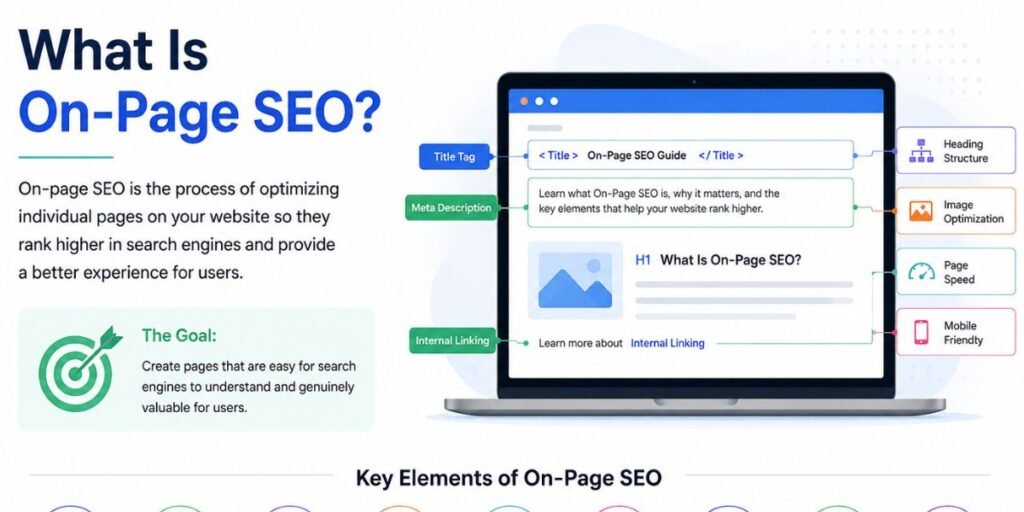
On-page SEO is the process of optimizing individual pages on your website so they can rank better in search engines and provide a better experience for visitors.
Unlike off-page SEO, which focuses on backlinks and external authority, on-page SEO involves everything that exists directly on your website, including:
- Content quality
- Keyword optimization
- Search intent
- Title tags
- Meta descriptions
- URL structure
- Heading hierarchy
- Internal linking
- Image optimization
- Page speed
- Mobile usability
- Schema markup
- User experience
- Content freshness
The goal is simple:
Create pages that are easy for search engines to understand and genuinely valuable for users.
Modern on-page SEO isn’t about stuffing keywords into paragraphs. Instead, it’s about organizing information in a way that answers questions clearly, builds trust, and helps users complete their goals.
Why On-Page SEO Matters
Search engine optimization has changed significantly over the last few years.
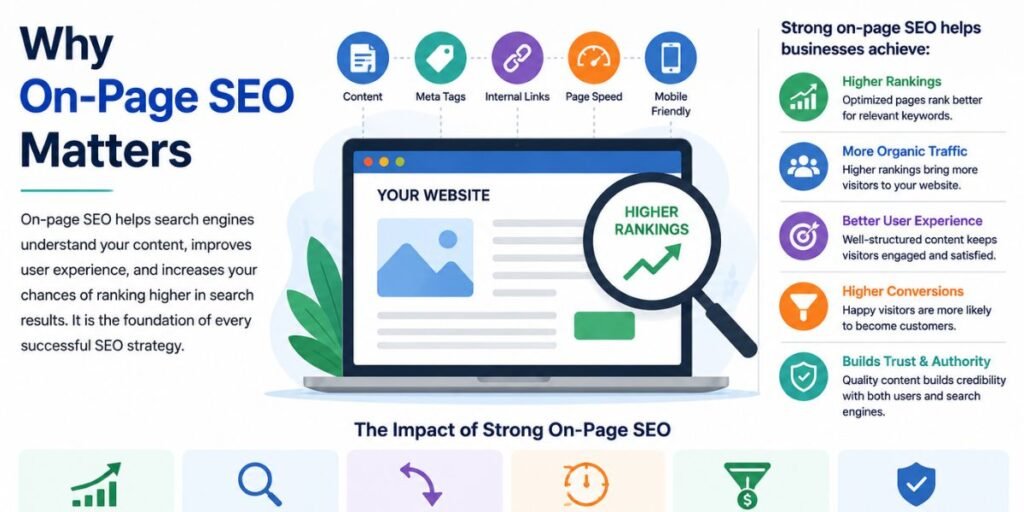
Google now uses advanced AI systems to better understand language, context, user intent, and content quality. Ranking well requires much more than technical optimization—it requires creating pages that provide meaningful value.
A well-optimized page helps Google understand:
- What your page is about
- Which audience does it serve
- How it compares with competing pages
- Whether users find it helpful
- Whether the information is trustworthy
- Whether the content demonstrates real expertise
Without proper on-page SEO, even an excellent website may struggle to rank.
Strong on-page optimization can help you:
- Increase organic traffic
- Improve keyword rankings
- Reduce bounce rates
- Increase user engagement
- Improve conversion rates
- Generate qualified leads
- Strengthen brand credibility
- Build long-term search visibility
Instead of chasing algorithm updates, businesses should focus on creating pages that deserve to rank because they genuinely solve users’ problems.
Google’s On-Page SEO Priorities
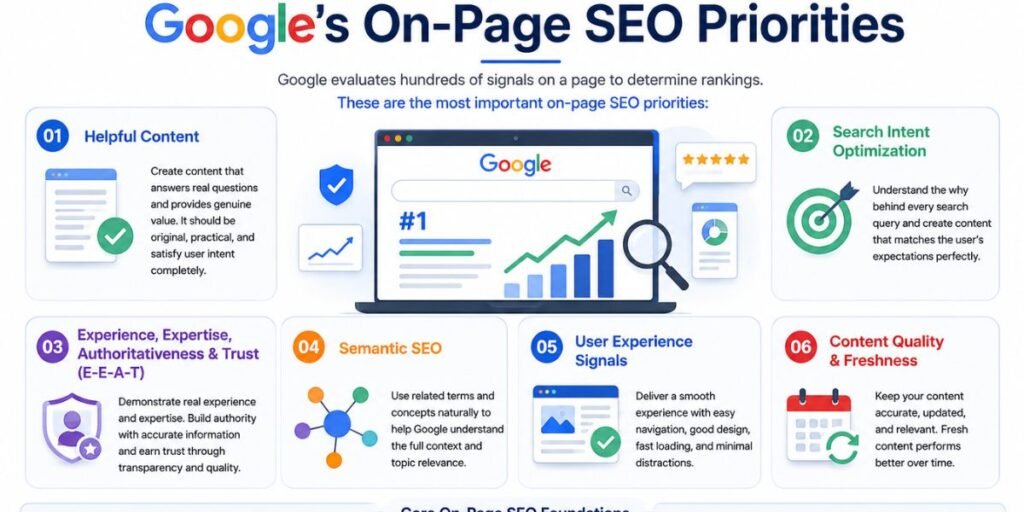
Google no longer rewards websites simply because they repeat keywords.
Today’s search algorithms evaluate hundreds of signals that reflect overall page quality.
Some of the most important ranking priorities include:
Helpful Content
Your content should answer real questions instead of existing only to rank.
Every section should provide useful information, practical advice, or clear explanations that leave users satisfied.
If visitors need to return to Google because your page didn’t answer their question, that’s a sign your content may not fully meet search intent.
Search Intent Optimization
One of the biggest ranking factors today is understanding why someone performed a search.
For example:
Someone searching for:
“What is On-Page SEO?”
expects an educational explanation.
Someone searching:
“On-Page SEO Services”
is looking for a company that can optimize its website.
Someone searching:
“How to improve on-page SEO”
expects practical steps they can apply.
Professional SEO pages address all relevant user intents naturally without losing focus.
Experience, Expertise, Authoritativeness & Trust (E-E-A-T)
Google wants to recommend websites that users can trust.
That means your pages should demonstrate:
- Real experience
- Professional expertise
- Accurate information
- Transparent business details
- Helpful guidance
- Updated content
- Clear service descriptions
Adding original insights, practical recommendations, and genuine expertise makes your content more valuable than pages that simply summarize existing information.
Semantic SEO
Google understands topics, not just keywords.
Instead of repeating “On-Page SEO” dozens of times, successful pages naturally include related concepts such as:
- Technical SEO
- Search intent
- Internal linking
- Content optimization
- Meta tags
- Page experience
- Keyword research
- Structured data
- Image SEO
- Core Web Vitals
- User engagement
- Crawlability
- Indexability
This creates stronger topical relevance and helps search engines understand your content more accurately.
User Experience Signals
Google wants users to enjoy using your website.
A well-optimized page should be:
- Easy to read
- Well structured
- Mobile friendly
- Fast loading
- Easy to navigate
- Visually organized
- Free from unnecessary distractions
Visitors should quickly find the information they came for without confusion.
Core Elements of Professional On-Page SEO
Effective on-page SEO involves many components working together. Improving only one area rarely delivers the best results.
Below are the most important elements every optimized page should include.
1. High-Quality Content
Content is still the foundation of on-page SEO.
However, quality is no longer measured by word count alone.
Great content should:
- Solve real problems
- Answer common questions
- Provide accurate information
- Include practical examples
- Stay up to date
- Be easy to understand
- Offer unique value instead of repeating competitors
Rather than writing for search engines, write for people first.
Search engines increasingly reward websites that educate, inform, and genuinely help their audience.
2. Strategic Keyword Optimization
Keywords remain important—but how you use them matters more than how many times they appear.
A well-optimized page naturally includes:
- Primary keyword
- Secondary keywords
- Long-tail keywords
- Semantic keywords
- Related entities
- Topic variations
Instead of forcing keywords into every paragraph, place them where they make sense:
- Title tag
- H1 heading
- Introduction
- Relevant H2 headings
- Image alt text
- URL
- Meta description
- Conclusion
Natural writing always performs better than keyword stuffing.
3. Optimized Title Tags
Your title tag is often the first thing users see in Google search results.
An effective title should:
- Clearly describe the page
- Include the primary keyword
- Encourage clicks
- Stay within the recommended length
- Reflect the page content accurately
A compelling title improves both rankings and click-through rates.
4. Meta Descriptions That Encourage Clicks
Although meta descriptions are not a direct ranking factor, they strongly influence whether users choose your page.
A good meta description should:
- Summarize the page
- Highlight the value users will receive
- Include the primary keyword naturally
- Encourage action without being misleading
Higher click-through rates often lead to stronger overall search performance.
5. Clean and User-Friendly URLs
Simple URLs improve usability and help search engines understand page topics.
For example:
Good
yourwebsite.com/on-page-seo-services
Avoid
yourwebsite.com/page?id=78264&service=seo123
Short, descriptive URLs are easier to remember, easier to share, and easier for search engines to interpret.
6. Proper Heading Structure
Headings improve readability and organize information logically.
A typical structure includes:
- One H1
- Clear H2 sections
- Supporting H3 headings
- Logical topic hierarchy
Visitors should be able to scan the page and locate the information they need.
Search engines also use headings to better understand page structure and content relationships.
7. Internal Linking That Improves Rankings
During our on-page SEO audits, we often discover important service pages receiving very few internal links. After strengthening the internal linking structure, search engines can crawl those pages more efficiently, and users can navigate the website more easily.
For example, if someone is reading about on-page SEO, they may also benefit from learning about:
- Technical SEO
- Keyword Research
- Content Marketing
- Local SEO
- Link Building
- SEO Audits
Linking these related pages naturally creates a stronger topical structure and encourages visitors to explore more of your website.
Best Practices for Internal Linking
- Use descriptive anchor text instead of generic phrases like “Click Here.”
- Link only to pages that genuinely add value.
- Keep important service pages within a few clicks from the homepage.
- Regularly update older articles with links to new content.
- Avoid excessive internal links that overwhelm readers.
When implemented correctly, internal linking improves navigation, increases engagement, and helps search engines understand the relationship between your content.
8. Image SEO
Images make content more engaging, but they also provide opportunities to improve SEO.
Search engines cannot “see” images the way people do. Instead, they rely on filenames, alt text, surrounding content, and structured data to understand what an image represents.
Optimized images can generate additional traffic from image search while improving page performance.
Image SEO Checklist
- Use high-quality, relevant images.
- Compress images without sacrificing quality.
- Choose modern formats like WebP when appropriate.
- Write descriptive filenames.
- Add meaningful alt text.
- Avoid uploading unnecessarily large files.
- Ensure images display correctly on mobile devices.
Optimized images help improve loading speed, accessibility, and user engagement.
9. Alt Text
Alt text (alternative text) describes an image for search engines and screen readers.
It improves accessibility for users with visual impairments while helping search engines understand image content.
Instead of writing:
Image1.jpg
Use descriptive alt text like:
“SEO specialist optimizing website content for better Google rankings.”
Good alt text should describe the image naturally without forcing keywords.
Avoid keyword stuffing such as:
“On-Page SEO, SEO Services, Best SEO, SEO Company, SEO Agency.”
Natural descriptions provide a better experience for everyone.
10. Content Readability
Even valuable information loses its impact if visitors struggle to read it.
A well-optimized page should be easy to scan and understand.
Improve readability by using:
- Short paragraphs
- Clear headings
- Bullet points where appropriate
- Simple language
- Active voice
- Logical section flow
- Consistent formatting
People often scan pages before reading every word. A clean layout helps them quickly find the information they need.
Better readability also increases the amount of time users spend on your website.
11. Content Freshness
Search engines prefer content that remains accurate and up to date.
SEO is constantly evolving, so outdated advice can reduce trust and rankings.
Regularly updating your content demonstrates that your website is actively maintained.
Updates may include:
- New Google recommendations
- Recent SEO best practices
- Updated statistics
- Improved examples
- Additional FAQs
- Better visuals
- Expanded explanations
Refreshing existing content is often more effective than publishing dozens of new pages.
12. Schema Markup
Schema markup is structured data that helps search engines understand your content more clearly.
While users usually don’t see schema directly, search engines use it to display enhanced search results.
Depending on your page, schema may help display:
- FAQs
- Reviews
- Ratings
- Business information
- Breadcrumbs
- Services
- Articles
Structured data doesn’t guarantee rich results, but it increases the chances of earning them.
It also improves communication between your website and search engines.
13. Core Web Vitals
Google considers page experience when evaluating websites.
Core Web Vitals measure how users experience your pages in real-world conditions.
The three primary metrics include:
Largest Contentful Paint (LCP)
Measures how quickly the main content becomes visible.
A faster loading page creates a better first impression.
Interaction to Next Paint (INP)
Measures how responsive your website feels after users interact with it.
Visitors expect buttons, forms, and menus to respond immediately.
Cumulative Layout Shift (CLS)
Measures visual stability.
Unexpected page movement during loading creates frustration and can lead to accidental clicks.
Improving these metrics enhances both user satisfaction and search performance.
14. Mobile-Friendly Design
Most searches now happen on mobile devices.
Google primarily evaluates the mobile version of your website when determining rankings.
A mobile-friendly page should include:
- Responsive design
- Readable text without zooming
- Proper spacing between buttons
- Fast loading speed
- Mobile-friendly navigation
- Easy-to-complete forms
If your website performs poorly on mobile, it may lose valuable traffic regardless of how strong the content is.
15. Crawlability and Indexability
Before Google can rank a page, it must first discover and understand it.
Technical issues can prevent valuable pages from appearing in search results.
Common problems include:
- Broken internal links
- Incorrect robots.txt settings
- Noindex tags
- Duplicate pages
- Poor website architecture
- Missing XML sitemaps
- Redirect chains
Professional on-page SEO includes identifying and resolving these issues so search engines can crawl your website efficiently.
16. AI Search Optimization
Search is changing rapidly.
Today, users don’t only search on traditional search engines. They also ask questions through AI-powered platforms that generate direct answers.
To remain visible, your content should be optimized for systems that understand context rather than simply matching keywords.
Effective AI-friendly content includes:
- Direct answers to common questions
- Well-structured headings
- Clear explanations
- Logical content hierarchy
- Natural language
- Reliable information
- Original insights
- Strong topical coverage
Content that genuinely helps users is more likely to appear in AI-generated summaries and conversational search experiences.
What’s Included in Our On-Page SEO Services
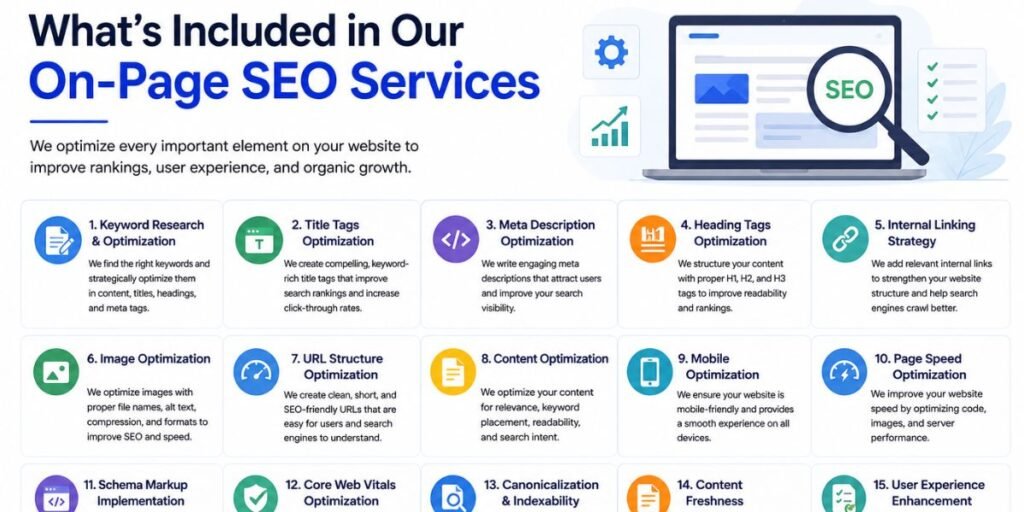
When you work with TheAlites, every important on-page SEO element is carefully optimized to improve both search visibility and user experience.
Our service includes:
- Comprehensive website audit
- Keyword research and keyword mapping
- Search intent optimization
- SEO-friendly title tags and meta descriptions
- Heading structure optimization (H1–H6)
- URL optimization
- Content optimization
- Internal linking strategy
- Image SEO and ALT text optimization
- Schema markup implementation
- Core Web Vitals recommendations
- Mobile usability improvements
- Crawlability and indexability review
- Technical on-page fixes
- Competitor analysis
- Actionable SEO recommendations
Step 1: Comprehensive Website Audit
We begin by identifying issues that may limit your website’s performance.
This includes evaluating:
- Existing content
- Meta tags
- Internal links
- Technical errors
- Site structure
- User experience
- Mobile usability
- Page speed
The audit provides a clear roadmap for improvement.
Step 2: Search Intent & Keyword Research
Instead of targeting keywords based only on search volume, we analyze what users actually want to achieve.
This helps us create pages that answer questions, solve problems, and match user expectations.
We also identify related topics and semantic keywords to strengthen topical authority.
Step 3: Competitor Analysis
Understanding what top-ranking competitors are doing helps uncover opportunities.
We evaluate:
- Content quality
- Topic coverage
- Heading structure
- Internal linking
- User experience
- Content gaps
Rather than copying competitors, we create content that provides greater value and a better user experience.
Step 4: Content Optimization
Our team improves every important content element, including:
- Headings
- Keyword placement
- Readability
- Semantic relevance
- Search intent alignment
- Calls to action
- Content depth
- Topical coverage
The result is content that is informative, engaging, and optimized for both users and search engines.
Step 5: Technical On-Page Improvements
Finally, we optimize the technical elements that support better rankings.
This includes:
- Title tags
- Meta descriptions
- URL structure
- Internal links
- Image optimization
- Schema markup
- Core Web Vitals
- Mobile usability
- Crawlability
- Indexability
These improvements ensure your pages are fully optimized for long-term organic growth rather than short-term ranking gains.
Our On-Page SEO Philosophy
We don’t believe in outdated SEO tactics or keyword stuffing.
Every recommendation we make is based on:
- Google’s latest best practices
- Search intent analysis
- User experience improvements
- Technical SEO standards
- Semantic optimization
- Long-term organic growth
Our objective is simple: create pages that deserve to rank because they genuinely help users.
Common On-Page SEO Mistakes That Hurt Rankings
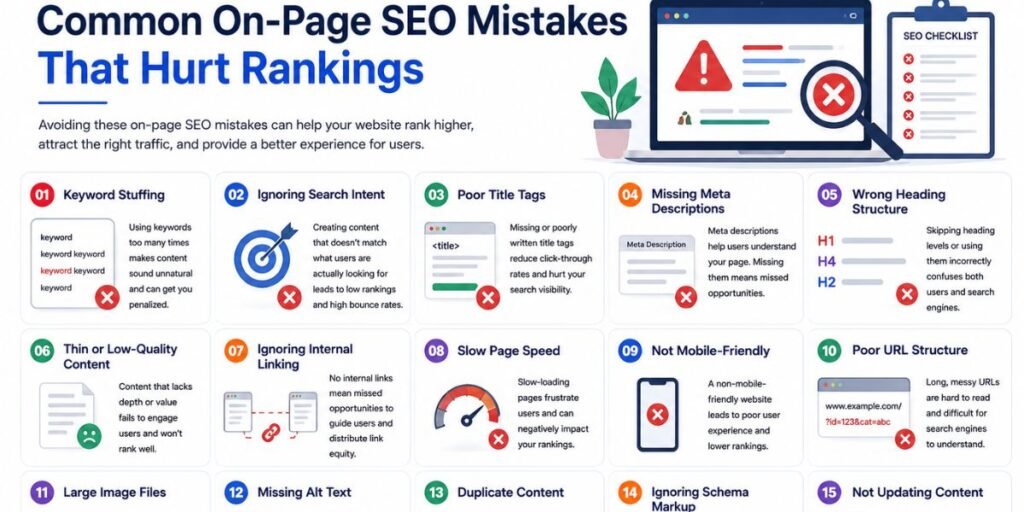
Many websites invest time and money in SEO but still struggle to rank because of common on-page mistakes. Even small issues can affect how search engines understand your content and how users interact with your website.
Here are some of the most common problems we identify during SEO audits.
1. Keyword Stuffing
Years ago, repeating the same keyword multiple times could help rankings. Today, it does the opposite.
Overusing keywords makes content difficult to read and signals poor quality to search engines.
Instead of forcing your target keyword into every paragraph, use natural language and include related terms that help explain the topic.
2. Thin or Low-Value Content
Publishing short pages with little useful information rarely performs well.
Google rewards content that answers questions thoroughly, demonstrates expertise, and provides real value.
Ask yourself:
- Does this page solve the visitor’s problem?
- Does it answer common questions?
- Is it more helpful than competing pages?
If the answer is “no,” the content likely needs improvement.
3. Ignoring Search Intent
A page may target the right keyword but still fail because it doesn’t match what users expect.
For example, someone searching for “On-Page SEO Services” wants to learn about professional optimization services—not just a basic definition of on-page SEO.
Understanding user intent is one of the most important aspects of modern SEO.
4. Poor Title Tags and Meta Descriptions
Titles that are too long, too vague, or missing important keywords can reduce click-through rates.
Similarly, weak meta descriptions may discourage users from visiting your page, even if it ranks well.
Every page should have a unique, descriptive title and a compelling meta description that accurately reflects its content.
5. Weak Internal Linking
Many websites publish valuable content but fail to connect related pages.
Without internal links:
- Search engines may overlook important pages.
- Visitors may leave without exploring additional resources.
- Valuable authority isn’t distributed effectively across the website.
A thoughtful internal linking strategy strengthens both SEO and user engagement.
6. Slow Page Speed
Visitors expect pages to load quickly.
If your website takes too long to display content, users may leave before they even start reading.
Improving image optimization, reducing unnecessary scripts, enabling browser caching, and optimizing code can significantly improve performance.
7. Duplicate Content
Publishing identical or nearly identical content across multiple pages can confuse search engines.
Whenever possible, create original content tailored to the specific purpose of each page.
Unique content helps establish topical authority and improves the overall quality of your website.
8. Poor Mobile Experience
A page that works well on desktop but performs poorly on smartphones can lose valuable traffic.
Ensure your website is responsive, easy to navigate, and fully functional across all screen sizes.
9. Missing Image Optimization
Uploading large images without compression or descriptive alt text slows down your website and limits visibility in image search.
Optimized images contribute to both better performance and improved accessibility.
10. Never Updating Content
SEO is not a one-time task.
Search trends, user expectations, and Google’s recommendations continue to evolve.
Regularly reviewing and improving important pages helps maintain rankings and ensures your content remains accurate and relevant.
Benefits of Professional On-Page SEO Services
Professional on-page SEO creates long-term value for your website. Rather than focusing on quick fixes, it builds a strong foundation for sustainable organic growth.
Some of the key benefits include:
Higher Search Engine Rankings
Well-optimized pages are easier for search engines to understand, increasing the likelihood of ranking for relevant keywords.
More Qualified Organic Traffic
Instead of attracting random visitors, effective on-page SEO helps bring users who are actively searching for your products or services.
This means higher-quality traffic with greater conversion potential.
Better User Experience
Clear navigation, organized content, faster loading times, and a mobile-friendly design make it easier for visitors to interact with your website.
A positive user experience encourages longer sessions and repeat visits.
Improved Conversion Rates
SEO isn’t just about rankings.
A well-structured page guides visitors toward meaningful actions, whether that’s requesting a quote, making a purchase, or contacting your business.
Increased Brand Credibility
Users are more likely to trust businesses that appear prominently in search results and provide clear, informative, and professional content.
Strong on-page SEO supports both visibility and credibility.
Long-Term Growth
Unlike paid advertising, organic traffic continues to generate value over time.
Once pages are properly optimized, they can continue attracting qualified visitors for months or even years with regular updates and maintenance.
Why Businesses Choose TheAlites for On-Page SEO?
Businesses choose TheAlites because we focus on sustainable SEO strategies that deliver measurable improvements—not short-term ranking tricks.
Here’s what sets us apart:
- SEO strategies based on Google’s latest best practices
- User-first content optimized for both people and search engines
- Complete on-page optimization—not just meta tags
- Transparent reporting and recommendations
- White-hat SEO with long-term results in mind
- Customized strategies for every industry and website
- Continuous improvement based on performance data
Our goal isn’t just to improve rankings—it’s to help your website attract the right audience and generate meaningful business growth.
Our Approach Includes:
Research-Driven Optimization
Every recommendation is based on keyword research, search intent analysis, competitor insights, and industry best practices.
User-First Content
We create content for people—not algorithms.
Our goal is to answer questions clearly, build trust, and provide useful information that encourages engagement.
Technical Excellence
From metadata and internal linking to structured data and Core Web Vitals, every technical element is carefully optimized to support better search performance.
Transparent SEO Practices
We follow ethical, white-hat SEO techniques aligned with Google’s recommendations.
No shortcuts.
No keyword stuffing.
No manipulative tactics.
Only sustainable strategies designed for long-term growth.
Continuous Improvement
SEO is an ongoing process.
We monitor performance, identify opportunities, and continually refine our strategies as search technology evolves.
Industries We Help
Our on-page SEO services can be tailored to businesses across a wide range of industries, including:
- eCommerce
- Healthcare
- Legal Services
- Real Estate
- Finance
- Education
- Technology
- SaaS
- Travel & Hospitality
- Manufacturing
- Home Services
- Automotive
- Professional Services
- Startups
- Local Businesses
Every industry has unique search behavior, and our optimization strategies are customized to match those specific needs.
Ready to Improve Your Website’s Search Performance?
Every page on your website has the potential to attract qualified visitors, generate leads, and grow your business—but only if it’s properly optimized.
At TheAlites, we combine content optimization, technical SEO, search intent analysis, and user-first strategies to help your pages perform better in Google and provide a better experience for your visitors.
Whether you need to optimize a few landing pages or an entire website, our team is ready to help.
Let’s build a stronger website together. Contact TheAlites today for a personalized On-Page SEO strategy.
Frequently Asked Questions
What is on-page SEO?
On-page SEO is the process of optimizing the content, structure, and HTML elements of individual web pages to improve their visibility in search engines and provide a better experience for users.
How long does on-page SEO take to show results?
Results vary depending on your website’s authority, competition, and existing optimization. Many websites begin seeing measurable improvements within a few months, although SEO should always be viewed as a long-term investment.
Is on-page SEO enough to rank on Google?
On-page SEO is essential, but it works best when combined with technical SEO, quality backlinks, helpful content, and a positive user experience.
How often should on-page SEO be updated?
Important pages should be reviewed regularly to ensure they remain accurate, competitive, and aligned with the latest search trends and Google recommendations.
Why is search intent important?
Matching search intent helps ensure your content answers the questions users are actually asking, leading to higher engagement and better rankings.
Does page speed affect SEO?
Yes. Faster pages generally provide a better user experience, and page experience is one of the many factors Google considers when evaluating websites.
Can on-page SEO improve conversions?
Absolutely. Well-organized content, clear calls to action, and a better user experience help turn visitors into customers.
Why should I choose TheAlites?
TheAlites combines modern SEO strategies, user-focused content, technical expertise, and ethical optimization practices to help businesses achieve sustainable organic growth.
What are the 4 types of SEO?
The four main types of SEO are On-Page SEO, Off-Page SEO, Technical SEO, and Local SEO. Together, they help improve your website’s visibility, user experience, and search engine rankings.
What is the difference between on-page and off-page SEO?
On-page SEO focuses on optimizing your website’s content, structure, and HTML elements, while off-page SEO involves building authority through backlinks, brand mentions, and external signals.
Which tool is best for on-page SEO?
There isn’t a single best tool, but popular options include Google Search Console, Screaming Frog, Ahrefs, Semrush, and Yoast SEO or Rank Math for WordPress websites.
What are the 4 pillars of SEO?
The four pillars of SEO are technical SEO, on-page SEO, high-quality content, and off-page SEO. Together, they create a strong foundation for sustainable organic growth.
What is on-page SEO in simple words?
On-page SEO means improving the content and elements on your website pages so search engines can understand them better and users can find the information they need more easily.
What improves on-page SEO?
High-quality content, relevant keywords, optimized titles, internal links, fast page speed, mobile-friendly design, and a great user experience all contribute to better on-page SEO.
How to do on-page SEO step by step?
Start with keyword research, create helpful content, optimize titles and headings, improve URLs, add internal links, optimize images, enhance page speed, and regularly update your content.