

Introduction:
Imagine starting a new website and publishing your first few articles. You want people to discover your content, but you’re unsure where to focus your efforts.
Should you optimize your website for Google so people can find it through search results? Or should you start posting regularly on Facebook, Instagram, Pinterest, and other social platforms?
This is a common question for new bloggers, small business owners, and anyone trying to build an online presence.
Search engine optimization (SEO) and social media marketing are two popular ways to reach an audience. Both can help people discover your content, learn about your business, and visit your website. However, they work differently and require different approaches.
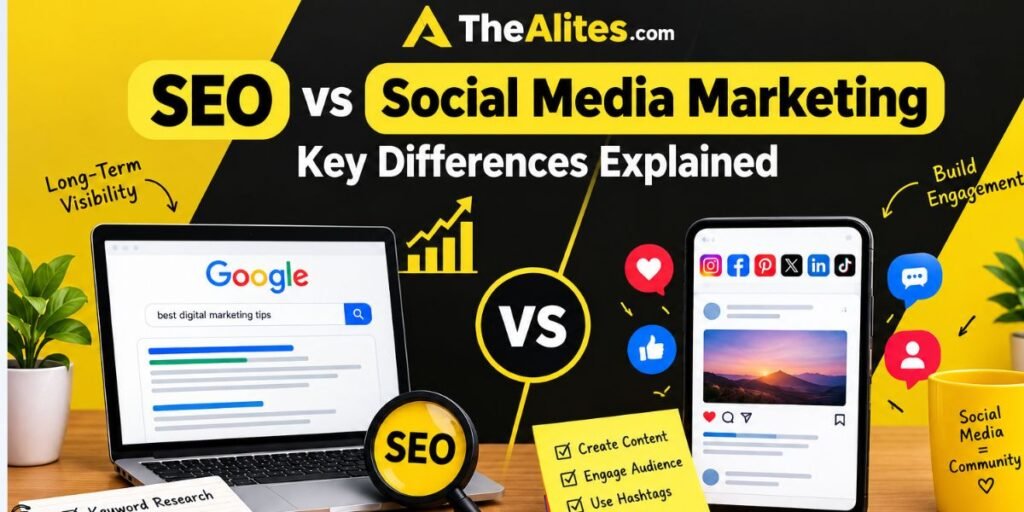
SEO focuses on improving your website’s visibility in organic search results. Social media marketing focuses on reaching and engaging people through social platforms.
One is not automatically better than the other.
Your ideal approach depends on your goals, available resources, audience behavior, and the type of content you create.
In this guide, we’ll explain SEO vs social media marketing in simple terms, compare their advantages and limitations, and explore how they can work together to support sustainable website growth.
What Is Search Engine Optimization (SEO)?
Search engine optimization is the process of improving a website so search engines can discover, understand, and present its content to relevant users.
For example, imagine someone searches Google for “how to start a vegetable garden.”
A gardening website with a helpful article covering soil preparation, seed selection, watering, and beginner mistakes may be relevant to that search.
SEO helps the website communicate what its article is about while making the content accessible and useful for readers.
According to Google’s official SEO Starter Guide, optimization involves helping search engines understand content and helping people decide whether to visit a website through search results.
SEO generally includes several connected activities.
Keyword research helps you understand what your audience searches for. On-page SEO involves improving titles, headings, internal links, and content structure. Technical SEO addresses issues such as crawlability, mobile usability, and website performance.
Content quality also plays a major role. Publishing genuinely useful information gives visitors a reason to read your articles and explore related pages.
For beginners, it’s important to understand that SEO is not simply about repeating keywords or installing an optimization plugin.
It’s an ongoing process of creating helpful content, maintaining a functional website, and making information easier to discover.
What Is Social Media Marketing?
Social media marketing involves using social platforms to communicate with an audience, distribute content, build awareness, and encourage meaningful interactions.
Popular platforms include Facebook, Instagram, Pinterest, LinkedIn, TikTok, and YouTube.
Each platform offers different content formats and audience behaviors.
For example, Instagram is often used for visual storytelling, short videos, and community interaction. LinkedIn is commonly associated with professional networking and business-related content. Pinterest is useful for discovering and saving visual ideas, including recipes, fashion inspiration, home decor, and tutorials.
A blogger might publish a detailed article on their website and then create a series of social posts introducing different parts of that article.
A small business could use social media to answer customer questions, demonstrate products, share updates, or build relationships with potential buyers.
Social media marketing includes both organic and paid activities.
Organic social media marketing involves publishing content and engaging with people without paying for advertising distribution. Paid social media marketing uses advertising tools to reach selected audiences.
Unlike SEO, which primarily aims to improve discoverability through search engines, social media marketing often involves reaching people while they’re browsing feeds, exploring recommendations, or interacting with communities.
This distinction influences the content you create and how you measure success.
SEO vs Social Media Marketing: Main Differences
Although SEO and social media marketing share some goals, their approaches to attracting visitors are different.
SEO often connects your content with people who are already searching for a particular answer, service, or product.
Social media marketing can introduce your content to people who weren’t actively looking for it.
Consider a website publishing home organization tips.
Someone searching Google for “how to organize a small bedroom” has expressed a clear interest in that subject.
Meanwhile, someone scrolling through Pinterest might discover a bedroom organization idea that catches their attention, even if they hadn’t planned to research the topic that day.
Both visitors could eventually reach the same article, but their discovery journeys are different.
Here’s a practical comparison:
| Feature | SEO | Social Media Marketing |
|---|---|---|
| Main focus | Organic search visibility | Social discovery and engagement |
| Primary channels | Google, Bing, other search engines | Instagram, Facebook, Pinterest, LinkedIn, etc. |
| Audience behavior | Often searches for specific information | Browses, follows, interacts, and discovers |
| Content format | Articles, guides, product pages, tools | Posts, videos, images, stories, discussions |
| Results | Often require sustained effort | Can generate attention quickly, but results vary |
| Traffic pattern | Can continue from established pages | Often depends on distribution and ongoing activity |
| Main measurements | Search impressions, clicks, rankings | Reach, engagement, followers, referral visits |
| Main challenge | Competition and search visibility | Audience attention and platform dependence |
These differences don’t mean SEO is always slow or social media always delivers immediate results.
A newly published social post might receive very little attention, while an established website can sometimes attract search traffic soon after publishing a relevant article.
The important lesson is that both channels operate under different discovery systems.
1. Difference in Audience Intent
Audience intent is one of the most important distinctions between SEO and social media marketing.
When people use a search engine, they frequently have a question or objective in mind.
They might want to compare two products, learn a skill, find a local service, or solve a technical problem.
For example, someone searching for “best free keyword research tools” is already interested in discovering keyword research solutions.
An article addressing that topic can serve the visitor’s existing need.
Social media behavior is often more exploratory.
Someone browsing Instagram might encounter a short tutorial, discover a brand through a friend’s recommendation, or become interested in a topic after seeing a useful post.
However, social platforms can also have strong search behavior. Pinterest, YouTube, and other platforms allow people to look for specific ideas and information.
The distinction is therefore not absolute.
For website owners, understanding audience intent helps determine which content belongs on which channel.
Detailed explanations and comparison articles are often suitable for organic search. Visual demonstrations, short tips, and engaging content previews can work well on social media.
2. Difference in Content Strategy
SEO and social media marketing require different approaches to content creation.
An SEO-focused article generally needs to address a specific topic thoroughly. Its title should accurately describe the content, its structure should help readers navigate the information, and its explanations should satisfy the intended search.
For example, a guide about improving website speed might cover performance metrics, testing tools, common causes of slow loading, and practical solutions.
The article should remain useful even when someone discovers it several months after publication.
Social media content often communicates ideas in smaller, platform-appropriate formats.
That same website speed article could become a short video demonstrating a PageSpeed Insights test, a carousel explaining Core Web Vitals, or a simple graphic highlighting common performance mistakes.
The goal isn’t to copy the entire article into every social post.
Instead, each post should provide a useful takeaway and, when relevant, encourage interested readers to explore the complete guide.
This approach makes content repurposing more efficient while respecting the different expectations people have on each platform.
3. Difference in Time and Traffic Potential
One common belief is that SEO takes months while social media produces instant traffic.
The reality is more complicated.
SEO often requires patience because search engines need to discover, process, and evaluate website content. Competition, website history, technical accessibility, and content quality can all influence results.
However, there is no universal waiting period that guarantees rankings.
An established article may continue attracting visitors through relevant searches without requiring a new promotional post every day.
Social media content can sometimes receive attention shortly after publication, particularly when it resonates with an existing audience or receives wider platform distribution.
But that attention isn’t guaranteed.
Some posts generate a short burst of visitors before activity declines. Others, particularly searchable or evergreen content, may continue receiving discovery over a longer period.
For a new blogger, this suggests a practical approach: build useful website content while experimenting with relevant social platforms.
That way, you’re not relying entirely on one source of visitors.
4. Difference in Cost and Resources
Neither SEO nor organic social media marketing is completely free when you consider the time and resources required.
You can perform basic keyword research, write articles, and use free search tools without purchasing an expensive SEO subscription.
However, producing quality content, maintaining a website, and resolving technical problems still require effort.
Similarly, creating a social media account may be free, but planning posts, editing videos, designing graphics, answering comments, and maintaining a consistent presence take time.
Paid social advertising introduces additional costs, depending on your campaign settings and chosen platform.
It’s also important to distinguish SEO from paid search advertising.
Organic SEO is not the same as purchasing Google Ads. Google states that paying for advertising does not improve a website’s organic search rankings.
When comparing costs, consider what you can realistically maintain.
A small blogger who enjoys writing may find SEO-focused articles easier to produce consistently. Someone comfortable creating videos and interacting with a community may prefer investing more time in social media.
The most effective channel is often the one you can support with quality work over time.
5. Difference in Measuring Performance
Both SEO and social media marketing provide measurable results, but the most useful metrics are not identical.
For SEO, Google Search Console helps website owners understand how their content performs in Google Search.
You can monitor impressions, clicks, click-through rates, and search queries to identify which pages attract attention.
For social media marketing, platform analytics typically provide information about content reach, engagement, audience activity, and interactions.
However, likes and followers don’t necessarily translate into website visitors.
A social post might receive thousands of views but generate relatively few visits to your website. Another post with a smaller audience might attract more interested readers.
Google Analytics can help you compare traffic sources. Its reporting distinguishes channels such as Organic Search, Organic Social, and Paid Social, allowing you to evaluate how visitors reach your website.
For bloggers, a useful measurement strategy includes looking beyond raw traffic numbers.
Consider whether visitors read your articles, explore related content, return to your website, or complete meaningful actions.
These indicators help you understand whether your marketing activities are attracting an audience that genuinely values your content.
Advantages and Disadvantages of SEO
SEO offers several benefits for websites that publish useful, searchable information.
One major advantage is the opportunity to reach people who already have an interest in your topic.
If you publish an article explaining how to improve WordPress performance, relevant search queries can help readers discover it when they need that information.
SEO also supports the development of a structured content library.
Instead of treating every article as an isolated publication, you can organize related topics, connect them through internal links, and gradually build a more useful website.
Another benefit is that existing articles can continue attracting search visitors after their original publication date, provided they remain relevant and visible.
However, SEO has limitations.
Competition can make certain keywords difficult to target. Technical issues can prevent content from being discovered correctly, and changes in search behavior may affect traffic.
SEO also requires ongoing maintenance. Articles sometimes need updated examples, revised information, or improved explanations.
Most importantly, there is no guarantee that optimizing a page will result in a particular ranking.
Google’s Search Essentials explain that meeting its requirements and best practices does not guarantee crawling, indexing, or visibility in search results.
SEO should therefore be treated as a long-term publishing and improvement process rather than a guaranteed traffic formula.
Advantages and Disadvantages of Social Media Marketing
Social media marketing gives website owners opportunities to communicate directly with people interested in their topics.
Unlike a traditional article, a social post can invite immediate interaction through comments, replies, shares, and conversations.
This makes social media useful for understanding audience questions and discovering which subjects generate interest.
Visual platforms can also help communicate ideas that are difficult to explain through text alone.
For example, a fashion blogger might publish an article containing outfit suggestions and then create Pinterest Pins highlighting individual looks.
A food blogger could share a short cooking demonstration that links to a complete recipe.
Social media is particularly useful when your content benefits from visual examples, community discussion, or regular updates.
However, maintaining an active presence requires consistent effort.
Platform distribution can change, and reaching followers isn’t always guaranteed. Content that performs well on one platform may receive little attention on another.
There is also a risk of becoming overly dependent on metrics that don’t support your actual goals.
A growing follower count can feel encouraging, but it shouldn’t be your only measurement if your primary objective is attracting interested readers to your website.
Does Social Media Marketing Directly Improve SEO Rankings?
This is one of the most frequently misunderstood areas of digital marketing.
Sharing an article on social media does not automatically increase its Google ranking. Likes, shares, and follower counts should not be treated as a guaranteed direct ranking shortcut.
However, social media can support your broader SEO efforts indirectly.
When people discover useful content through social platforms, some may visit your website, recommend the article to others, or reference it in their own publications.
These activities can introduce your website to audiences who might otherwise never encounter it.
Google’s SEO Starter Guide includes social media promotion among the ways website owners can help interested people discover new content.
The distinction matters.
Publishing a link on Facebook doesn’t mean Google will reward your page with higher rankings. But promoting genuinely helpful content can create opportunities for discovery, readership, and relevant references.
Rather than treating SEO and social media as competing ranking tactics, think of them as separate marketing channels that can complement one another.
SEO vs Social Media Marketing: Which Is Better for Beginners?
If you’re starting a new website, your decision should begin with your main objective.
For someone building an informational blog, SEO is often a sensible foundation because the website’s primary purpose is to answer questions and provide searchable information.
For someone developing a visually oriented brand, social media may deserve greater attention from the beginning.
Consider three common examples.
Example 1: A New Informational Blog
Imagine starting a blog about website management and beginner-friendly digital marketing.
You could publish articles addressing questions such as how to use Google Search Console, how to improve website speed, and how to find relevant keywords.
These subjects naturally suit search-based discovery because readers often look for specific explanations.
You could then repurpose each article into smaller educational posts for social media.
In this situation, SEO provides the main content foundation while social media helps distribute it.
Example 2: A Fashion and Lifestyle Website
A fashion website might publish detailed articles about seasonal outfits, clothing combinations, and styling advice.
Those articles can target relevant search queries.
At the same time, visual platforms such as Pinterest and Instagram can showcase individual outfit ideas and encourage people to explore the complete guides.
Here, combining search optimization with visual content distribution makes practical sense.
Example 3: A Small Local Business
A local business might benefit from search visibility when people look for nearby products or services.
However, social media can help it share updates, answer questions, and communicate with existing customers.
The appropriate balance depends on how its customers typically discover and evaluate businesses.
These examples demonstrate why choosing a marketing channel should depend on audience needs rather than broad claims that one method is always superior.
How to Combine SEO and Social Media Marketing
You don’t necessarily need two completely separate content strategies.
A more manageable approach is to create valuable website content first and then adapt relevant parts for the social platforms your audience uses.
For example, imagine publishing a detailed article titled “How to Improve Website Speed.”
You could build a simple content distribution plan around that single resource.
| Content format | Purpose |
|---|---|
| Complete website article | Explain the topic thoroughly |
| Pinterest graphic | Highlight website speed improvement tips |
| Instagram carousel | Explain common performance mistakes |
| Short educational video | Demonstrate a speed test |
| Facebook post | Introduce the article and encourage discussion |
| LinkedIn post | Discuss the importance of website performance |
Each format should provide its own useful information instead of functioning as an empty advertisement.
The social posts can direct interested visitors to the complete article when additional explanation would genuinely help them.
This process is often called content repurposing.
It allows you to explore several discovery channels without having to invent an entirely new subject for every publication.
Google also recommends creating original, helpful content that serves a real audience rather than producing material primarily to manipulate search rankings.
A Simple 30-Day Marketing Plan for a New Website
Beginners sometimes spend so much time comparing marketing strategies that they delay publishing anything.
A practical first-month plan can help you move forward without attempting to master every platform simultaneously.
During the first week, identify your audience and select a few related topics they genuinely care about. Research the questions they ask and organize those questions into useful article ideas.
In the second week, publish your first substantial articles. Focus on clear explanations, helpful examples, descriptive headings, and relevant internal links.
During the third week, select one or two social platforms that suit your content format. Create several useful posts based on your published articles.
In the fourth week, review your available performance data. Check whether your articles are receiving search impressions, whether social posts are generating interactions, and whether visitors are reaching your website.
Use those observations to adjust the following month’s plan.
For example, if a social post generates several questions about a topic, those questions might inspire a more detailed website article.
Similarly, if Search Console reveals that people discover your content through an unexpected query, you might create a social post explaining that particular subject.
The goal of this plan isn’t to promise meaningful traffic within 30 days. It’s to establish a repeatable publishing and measurement routine.
Common Mistakes to Avoid
One common mistake is expecting SEO or social media marketing to produce guaranteed results within a fixed timeframe.
Both involve factors outside your direct control, including competition, audience behavior, and the systems used to distribute content.
Another mistake is publishing identical promotional messages across every social platform.
A format that works on Pinterest may not communicate effectively on LinkedIn or Instagram. Adapt your content to the platform while keeping the underlying information accurate.
Website owners should also avoid focusing exclusively on traffic numbers.
A smaller audience genuinely interested in your subject can be more valuable than a large number of visitors who immediately leave because the content doesn’t meet their expectations.
Finally, don’t neglect your website while investing in social media.
Your social profiles can introduce people to your content, but visitors still need a functional destination with readable articles, clear navigation, and useful information.
A balanced approach prioritizes the quality of the experience across both channels.
Frequently Asked Questions
1. What is the main difference between SEO and social media marketing?
SEO focuses on improving a website’s visibility in organic search results. Social media marketing focuses on reaching and engaging audiences through social platforms. Both can generate website visits, but their discovery methods differ.
2. Is SEO better than social media marketing?
Neither is universally better. SEO is often suitable for websites publishing searchable information, while social media can be particularly useful for visual content, community interaction, and audience communication.
3. Can social media marketing help SEO?
Yes, indirectly. Social media can introduce your articles to new readers and create opportunities for content discovery and references. However, social shares do not guarantee improved Google rankings.
4. Which strategy is more affordable for beginners?
Both can be started with free tools, but each requires time and effort. SEO may involve website maintenance and content creation, while social media requires planning, production, and audience engagement.
5. Does SEO generate traffic faster than social media?
There is no universal answer. Results depend on your website, content, competition, audience, and distribution. Neither channel guarantees traffic within a particular timeframe.
6. Should bloggers use both SEO and social media?
Using both can be beneficial when resources allow. Bloggers can publish useful search-focused articles and repurpose relevant information into social content that introduces new readers to their websites.
7. Is Pinterest considered SEO or social media marketing?
Pinterest is a visual discovery platform with search functionality. Creating relevant Pins, using descriptive text, and linking to useful destination pages can form part of a broader content distribution strategy.
8. How can I measure SEO and social media traffic separately?
Google Search Console helps you evaluate Google Search performance. Google Analytics can distinguish website visits from channels such as Organic Search, Organic Social, and Paid Social, depending on your tracking setup.
Conclusion
SEO and social media marketing are different approaches to reaching people online, but they don’t need to compete for your attention.
SEO helps search engines understand your website and connects your content with people looking for relevant information. Social media marketing provides opportunities to introduce your content, communicate with audiences, and encourage discovery through different platforms.
For a new informational website, building a library of useful articles is a strong starting point. Social media can then support that content by presenting its ideas in formats appropriate for different audiences.
Instead of asking which marketing channel is always better, consider which combination fits your goals, resources, and readers.
A thoughtful strategy focuses on creating valuable content, distributing it responsibly, measuring meaningful results, and improving over time.
| Official reference | Recommended use |
|---|---|
| Google SEO Starter Guide | SEO definition and best practices |
| Creating Helpful, Reliable, People-First Content | Content quality and publishing |
| Google Search Essentials | Search eligibility and limitations |
| Google Search Console | Measuring organic search performance |
| Google Analytics: Default Channel Group | Distinguishing search and social traffic |
| Google: Do You Need an SEO? | Organic search versus paid advertising |